Gross vs net rental yield: what Saudi landlords actually keep
How gross rental yield turns into net yield in Saudi Arabia, worked on a Riyadh district and two listed funds, with the costs no authority publishes.
A Riyadh apartment in An Narjis returned 4.34% gross in Q3 2025, on REGA's own rent and sale figures. Working out the net figure is harder. Saudi law sets out every cost that sits between the two, but only one of those costs has a published price.
Gross yield is a year's rent divided by the price. Net yield is what the landlord keeps once service charges, empty months, letting fees and tax are paid. In our worked example below, a single service charge takes An Narjis from 4.34% to 2.80%.
Gross rental yield vs net rental yield, worked on one district
An Narjis is the district with the most data on both sides. REGA records apartment rents there at SAR 403.34 per sqm a year, across 4,131 leases (rent file). Sale prices averaged SAR 9,292.09 per sqm on 209 deeds (sales file). Q3 2025 is also the last quarter in which REGA published a sale price by neighbourhood.
Both figures are REGA's. We only do the division, so we checked that the two sides describe the same product. The average rented apartment works out at 127.7 sqm and the average sold one at 129.6 sqm, 1.5% apart, which is close enough.
REGA's per-metre column is an average of ratios. Taking total value over total area gives SAR 9,094.46 instead, and a yield of 4.43%, a gap of only nine basis points. That is the method behind our neighbourhood yield grid.
Changing the comparison area moves the yield far more. Set the same rent against the Riyadh-wide apartment price of SAR 6,044.07 per sqm and the yield jumps to 6.67%, only because the comparison area is cheaper. Even inside An Narjis, REGA's own price range moves the yield between 3.58% and 5.18%.
Coverage is thin: only 48 of 185 Riyadh neighbourhoods with an apartment rent also have a sale price, and the sales file stopped reporting neighbourhoods after Q3 2025.
What comes off the top, and what the law fixes
Five costs sit between gross and net. Only the letting fee has a published level: 2.5% of the first year's rent, under the Brokerage Law gazetted on 22 July 2022 and in force 180 days later (Umm Al-Qura, Articles 14 and 24). No authority publishes a residential management fee.
| Deduction | What the law fixes | Source |
|---|---|---|
| Service charge | Compulsory, and no owner may renounce the common parts to escape it (Art 24(3)); apportioned by unit area (Art 26(1)); budget voted annually | Law M/85, regulations, 2020 |
| Letting fee | 2.5% of the deal, or of the first year's rent on a lease, unless agreed otherwise in writing | Brokerage Law, Art 14(1), 2022 |
| Tax on rent | Residential leases VAT-exempt, commercial 15%; 5% withholding on rent paid to a non-resident, on the gross | VAT Regs, Art 30; ZATCA, May 2026 |
| Vacancy | Fee on units unused six months, read off utility meters, capped at 5% of building value | Vacant Properties Fees Regulation, 15 May 2026 |
The 5% transaction tax is often put in the wrong column. Under Article 7(1) the seller pays it, on every sale since 10 April 2025 (Umm Al-Qura). If a buyer agrees to carry it and adds it to the purchase cost, An Narjis falls from 4.34% to 4.134%. For a citizen buying a first home, the State pays the tax on the first SAR 1,000,000, so the tax still applies above that (ZATCA, Version 6; the tax in detail).
At 21 basis points, the tax matters far less than the 160-point spread from REGA's price range inside the district.
Watching gross turn into net in audited accounts
Listed funds are the only place in Saudi Arabia where the costs are printed line by line. They still never print a yield. Derayah REIT booked SAR 100,305,291 of rent in FY2025, on an average valuation of SAR 1,593,724,000 (Annual Report 2025). That is 6.294% gross.
Operating and fund costs bring it down to 5.421%, and financing takes it to 2.834%, so debt took three times as much as running costs.
The bigger leak was rent never collected: Derayah failed to collect 23% of FY2025 revenue, about seven times its property operating line of SAR 3,468,555.
Net can even be negative: Mulkia Gulf Real Estate REIT earned revenue of 8.81% of total assets and spent 10.73% in FY2025, a loss of SAR 28,361,977 (Mulkia REIT).
Its Al-Maather building in Riyadh shows how a yield can rise for the wrong reason. Rent stayed at SAR 20,000,000, but the valuer marked the building down, so the gross yield went from 8.94% to 9.11% at 31 December 2025.
No Saudi fund publishes a net initial yield. The closest is the 7% to 8% cap rate range Mulkia's valuers used at 31 December 2025 (fair-value note). A cap rate is a valuer's assumption, and collected rent can fall short of it. Our note on yield on cost against cap rate covers the difference, and REIT filings let you check it.
The two lines with no published level
Nobody in the Kingdom publishes a level for service charges or for vacancy. GASTAT tracks service charges only as a rate of change: up 3.442% year on year in July 2026 (GASTAT).
Ejar, the national lease register, only records signed leases, so nobody can check the full year of rent that a gross yield assumes. The only public vacancy figures come from individual funds. Mulkia's vacant share rose from 5.76% at 31 December 2024 to 12.65% a year later (Mulkia REIT), but that is one fund and tells us little about the market.
What the unpriced costs could do to An Narjis
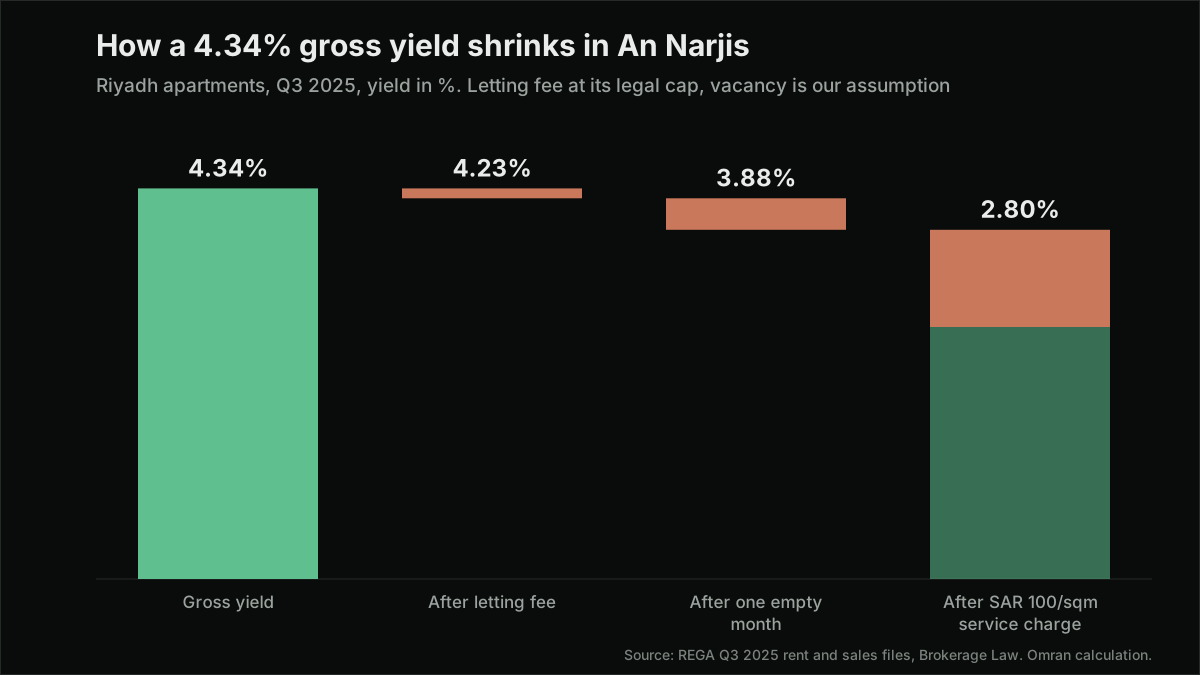
| Step (Omran estimate) | Yield |
|---|---|
| Gross, Q3 2025 | 4.34% |
| Letting fee at its 2.5% legal cap, re-let every year | 4.23% |
| One empty month a year (our assumption) | 3.88% |
| Service charge of SAR 100 per sqm a year | 2.80% |
Service charges are levied per sqm, so they come straight off the rent per sqm. Here each SAR 100 costs about 108 basis points, five times the transaction tax.
For a Riyadh landlord this gets worse over time. Rents inside the city are frozen for five years from 25 September 2025 (REGA), while a service charge growing at July 2026's rate would rise 18.4% over the same period. Before buying, ask for the building's approved budget. Ask for the underlying table for your district, or start with the Riyadh districts.
FAQ
What is the difference between gross rental yield and net rental yield? Gross is annual rent divided by price. In An Narjis that is SAR 403.34 over SAR 9,292.09 per sqm, or 4.34% in Q3 2025. Net is what is left after service charges, vacancy, letting fees, management and tax. Only the letting fee has a published Saudi price.
Is the 5% transaction tax part of my yield calculation? Only if you agreed to pay it, because Article 7(1) puts it on the seller. In An Narjis it costs about 21 basis points of yield.
Where do I find the service charge for a building I am buying? It is not public. The owners' general assembly approves a budget each year, and your share follows your unit's area. Ask for that budget and the subdivision document before you sign.
Can I use a "6 to 8% net" rule of thumb? No Saudi publication supports one. Those figures come from private brokerage surveys or from UK and Australian landlord guides. Their costs (council tax, monthly agent fees, income tax on rent) do not apply here, and they leave out the Saudi costs that do.
Sources
- REGA, quarterly rental indicators, Riyadh region Q3 2025, under the KSA Open Data Licence: link
- REGA, quarterly sales-transaction indicators, Riyadh Q3 2025: link
- MOMRAH, strata Law M/85, Articles 24(3) and 26(1): link
- REGA, implementing regulations of that Law, Articles 30 and 34: link
- Umm Al-Qura, Real Estate Brokerage Law, Article 14: link
- Umm Al-Qura, Real Estate Transaction Tax Law, Articles 2(1) and 7: link
- ZATCA, Detailed Guideline for RETT, Version 6, May 2026: link
- ZATCA, VAT Implementing Regulations, Article 30 (residential lease exemption): link
- ZATCA, General Guideline for Withholding Tax, May 2026: link
- Umm Al-Qura, Vacant Properties Fees Implementing Regulation, Articles 6, 7 and 8(5): link
- GASTAT, Consumer Price Index tables, July 2026: link
- Derayah REIT, Annual Report 2025: link
- Mulkia Gulf Real Estate REIT, Annual Report 2025: link
- REGA, Riyadh five-year rent freeze, 25 September 2025: link