Yield on cost vs cap rate, explained through one Riyadh mall
How yield on cost and cap rate differ, and why the gap between them is a developer's margin. We work it through on a Riyadh mall with a published budget.
A developer makes money on the gap between what a building yields on its cost and the yield at which it can be sold. Take The Elite Mall in Riyadh, whose full build budget appears in a 2026 valuation report. There, the developer's margin comes to 53 basis points, about half a percentage point.
What each ratio measures
Both ratios start from net operating income, which is rent after vacancy and running costs. Yield on cost divides it by what the building cost to deliver, land included. A cap rate divides it by what the finished building is worth today.
Build at 8.5%, sell at 8%, and the difference is the developer's profit.
Neither number is published as an official series. They exist because the Capital Market Authority makes listed funds revalue every six months through two accredited valuers, and publish the reports with their assumptions (CMA).
Two valuers, two very different cap rates
On 30 June 2026 Qiam and Esnad both valued The Elite Mall in Al Sulaymaniyah for the Mulkia Gulf REIT. Their values were close, SAR 180,360,000 and SAR 175,656,000, but they started from very different income.
Qiam worked from the landlord's rent roll at the 75.81% occupancy it found on site. Esnad said that data "does not fully reflect market conditions" and used market rents with 10% vacancy instead. Divide each firm's income by its own value and you get 5.64% for Qiam and 8.75% for Esnad. The values were only 2.7% apart. The incomes were 51% apart, so the cap rate absorbs the whole difference.
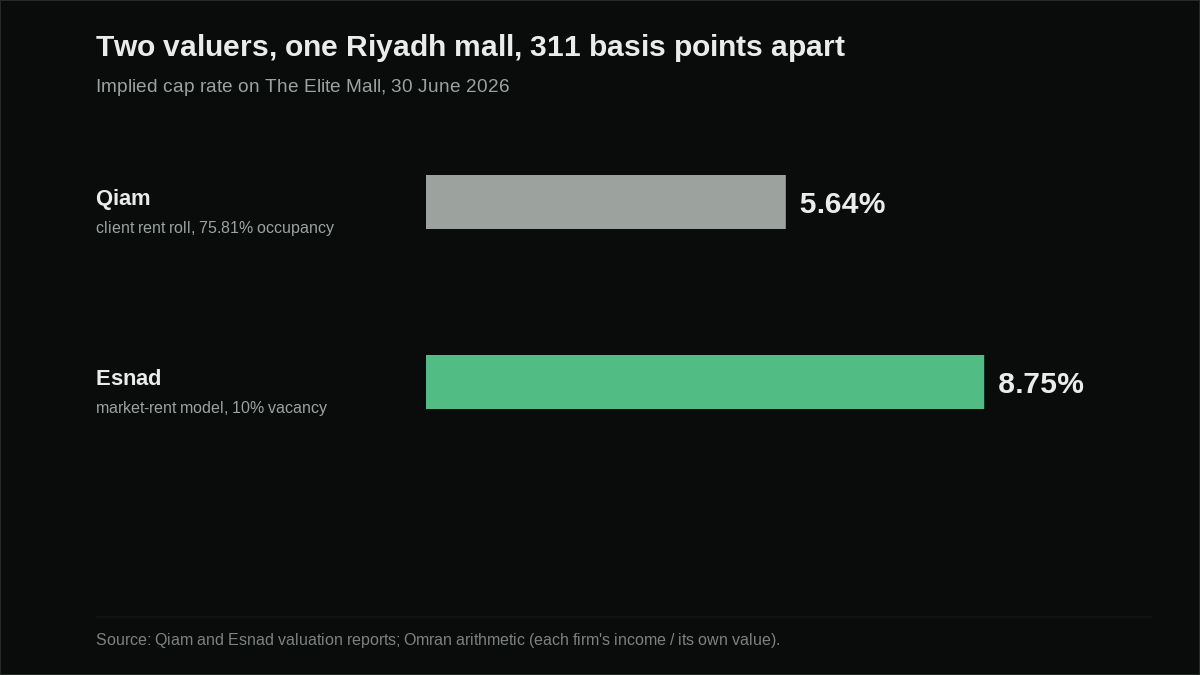
So when someone quotes a Saudi cap rate, ask whose income sits on top of it. Mixing one firm's income with the other firm's value gives a number that describes no real building.
The development margin is thin
Qiam's report also prints a complete cost budget for the mall, covering land and construction, with finance set at zero. That gives a cost base of SAR 161,659,368 before developer's profit (Qiam).
The stabilised income Qiam projects from 2031, SAR 13,796,699, yields 8.53% on that cost. Against the 8.00% cap rate used in the same report, the developer keeps a margin of 53 basis points.
Then add one year of published build inflation. GASTAT's non-residential cost index rose 2.56% in the year to July 2026 (GASTAT). Over a two-year build, that raises construction costs by 5.19%. The mall costs more for the same income, so yield on cost falls to 8.36% and the margin shrinks to 36 points.
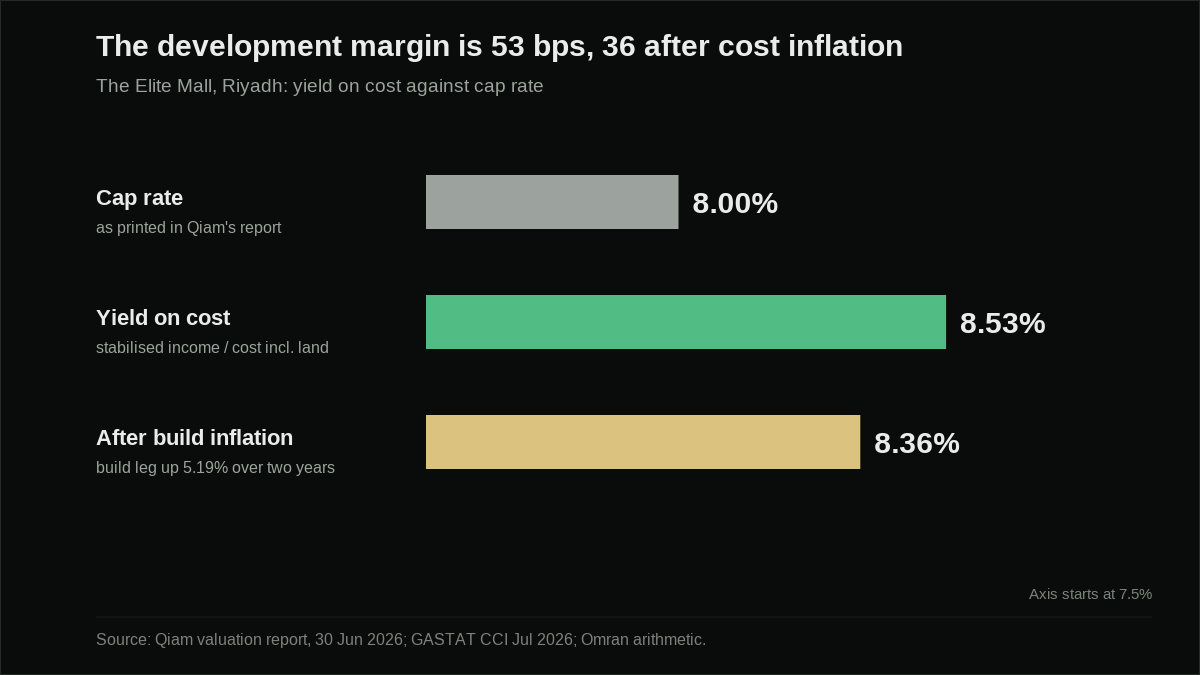
That still leaves out interest during construction and the 5% transaction tax on land (ZATCA). Both would come out of the 36 points that remain.
How far cap rates spread within a city
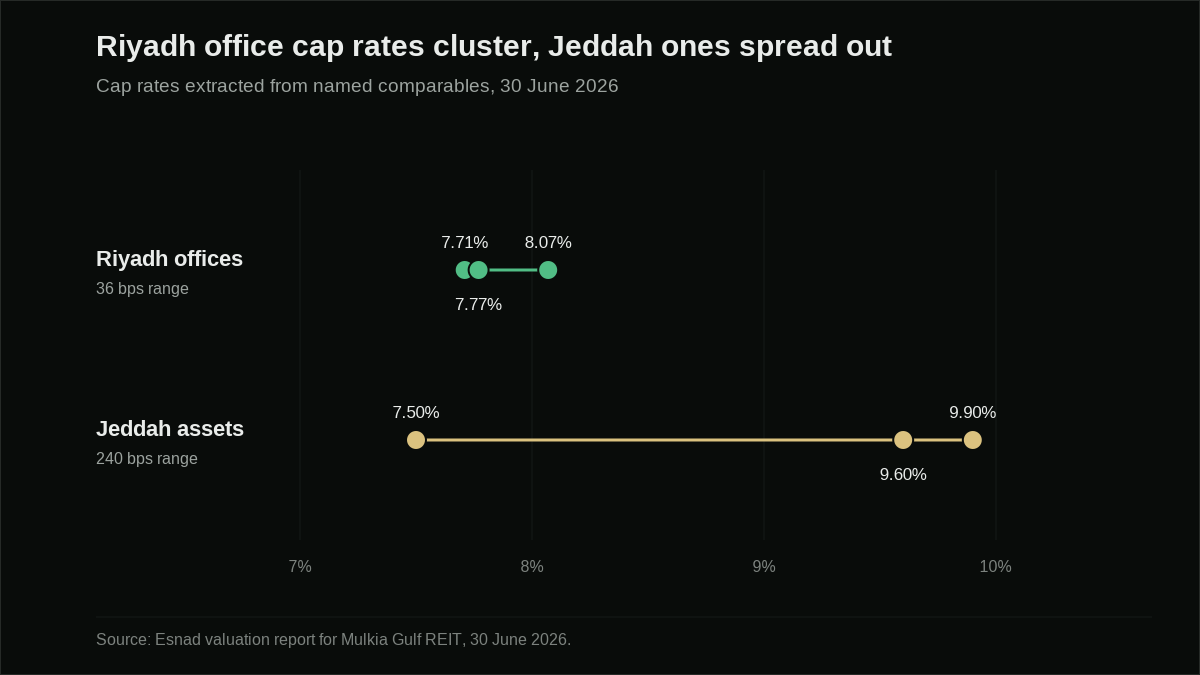
Esnad's report lists named comparable buildings with their value and income, so each cap rate can be checked. Three Riyadh office towers sit between 7.71% and 8.07%. The middle one is at 7.77%, and the full spread is 36 basis points. Jeddah is far looser, with a spread of 240 basis points. Its office comparable sits at 7.50%. Al Salamah Mall is at 9.60% and the Al-Khamra warehouses at 9.90% (Esnad).
When valuers choose a rate themselves instead of extracting it from sales, the numbers get rounder. Valie valued sixteen assets in the same fund at 31 December 2025 using only 8.00%, 7.50% or 7.00%. Half-point steps like these look like a judgement call (Valie).
You cannot rebuild this from open data
For commercial property the rent side is missing. REGA's Q4 2025 Riyadh file covers 56,258 commercial leases and prints zero in every rent column (REGA). The cost index has no SAR per sqm and leaves out land. Only fund valuation reports carry both. Ask for the asset-level cap rate and cost table.
FAQ
What is the difference between yield on cost and a cap rate? Yield on cost is stabilised net operating income over what the scheme cost, land included. A cap rate is the same income over what the finished building is worth. The gap between the two is the developer's margin.
Is there a published cap rate for Saudi Arabia? No. The closest figures are valuers' extraction tables, such as 7.71% to 8.07% on three Riyadh offices at 30 June 2026.
Why do two valuers reach different cap rates for the same building? They start from different income. On The Elite Mall one used the rent roll, the other market rents, and the implied rates came out at 5.64% and 8.75%.
Sources
- CMA, Real Estate Investment Funds Regulations as amended 21 May 2025: link
- Esnad Real Estate Valuation Co., valuation report for Mulkia Gulf REIT, 30 June 2026: link
- Qiam and Partner Real Estate Valuation Co., valuation reports for the same fund, 30 June 2026: link
- Valie for Real Estate Valuation, report V-121256, 31 December 2025: link
- GASTAT, Construction Cost Index July 2026: link
- REGA quarterly rental indicators, Riyadh region Q4 2025: link
- ZATCA, Real Estate Transaction Tax at 5%: link