What Riyadh's five-year rent freeze means for landlords
Riyadh rents are frozen for five years from 25 Sep 2025, for homes and shops alike. How the rules work, what a breach costs, and how fast rents had been rising.
Since 25 September 2025, landlords in Riyadh cannot raise rents, and the rule runs for five years, to September 2030 (REGA). It covers homes and commercial units, old leases and new ones, anywhere inside the city's urban boundaries.
Key figures at a glance
| Metric | Value | Scope | As of | Source |
|---|---|---|---|---|
| Duration and start | 5 years from 25 Sep 2025 | Riyadh urban boundaries | 25 Sep 2025 | REGA |
| Re-let rule | Rent fixed at the last executed Ejar contract | Previously-leased vacant units | 25 Sep 2025 | REGA |
| Fine for violation | Up to 12 months' rent, plus fixing the breach and compensation | Per violation | 25 Sep 2025 | REGA |
| National actual-rent inflation | +10.6% in FY2024, +4.4% in Jun 2026 | KSA, national CPI | Jun 2026 | GASTAT / Arab News |
| Enforcement rail | 10M+ Ejar contracts, ~19,000/day | KSA national platform | Sep 2024 | REGA/Ejar |
What the Riyadh rent freeze covers
The rules come from a Royal Decree backed by a Council of Ministers resolution (REGA, 25 Sep 2025). It stops any increase in the total rent on residential and commercial leases in Riyadh for five years from 25 September 2025.
The re-let rule matters more than the headline freeze. When a unit that was leased before falls vacant, the new rent "shall be fixed according to the Total Rental Value of the last executed 'Ejar' Contract". Only units never leased before can be priced freely.
So a landlord cannot reset to market by changing tenants. The one place prices can still move is the first lease of a newly built unit.
Can a landlord increase rent in Riyadh now?
No. In most cases the landlord cannot refuse to renew either. Leases across Saudi cities now renew automatically unless one side gives 60 days' notice. In Riyadh, REGA allows a refusal on five grounds. Three apply to any lease (REGA, 25 Sep 2025):
- the tenant has not paid;
- structural defects make the building unsafe for the people living in it;
- the landlord wants the unit for himself or a first-degree relative.
The other two are narrower and depend on the unit rather than the tenant: a major renovation that changes the rental value, or a unit whose last lease was signed before 2024. Unregistered contracts must go onto Ejar, the national lease register. The other party then has 60 days to object, and a penalty decision can be appealed within 30 days.
A breach costs up to 12 months' rent, plus putting things right and compensating the tenant. Anyone whose tip leads to a confirmed breach, other than enforcement staff, can receive up to 20% of the fine.
Why Riyadh froze rents
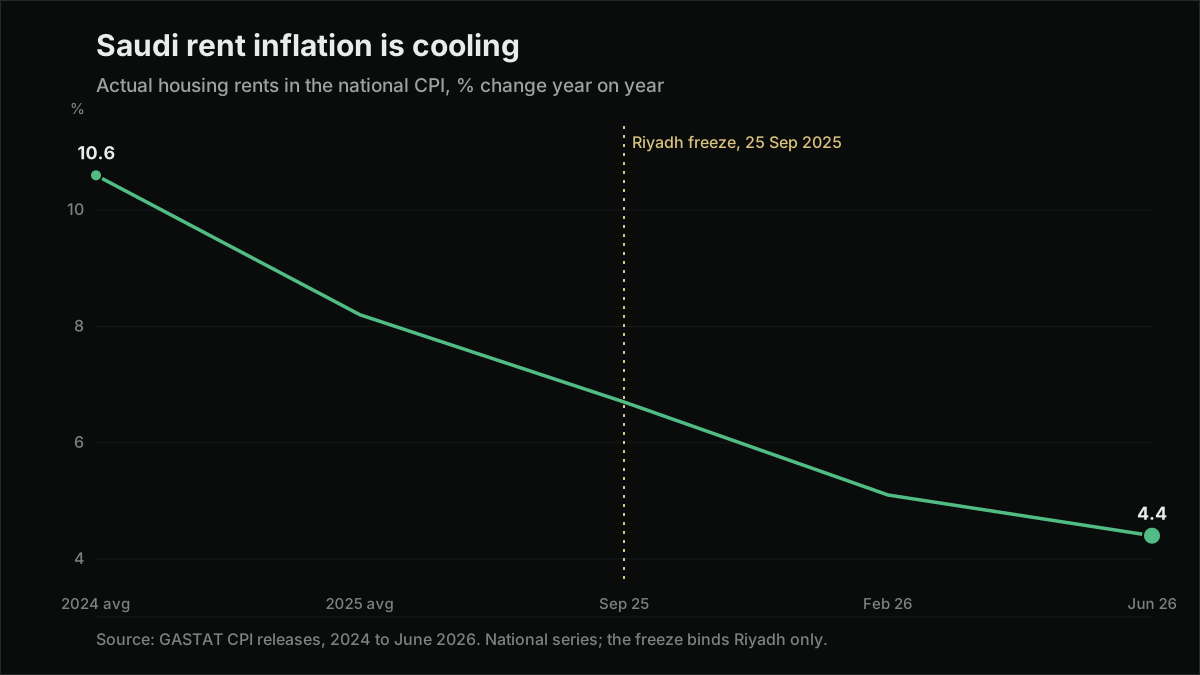
GASTAT's national index of actual housing rents rose 10.6% on average in 2024 (GASTAT Annual CPI 2024). It averaged 8.2% across 2025 (GASTAT via GCC Business Watch, Jan 2026) and was still 6.7% in September 2025, the month of the freeze (GASTAT CPI Sep 2025).
Rent makes up about 21% of the consumer price basket (Al-Eqtisadiah, Mar 2025). With that weight, rent was the main thing keeping headline inflation up (1.7% in 2024).
Riyadh was the worst hit. The same Al-Eqtisadiah piece puts the average household rent in the capital up 60% between 2021 and end-2024, a calculation on GASTAT's index rather than a published figure. Commercial space rose faster: SAMA's index shows commercial values up 25.7% since 2021, against 19.3% for residential (SAMA Financial Stability Report 2025). Our Riyadh office market analysis covers that side.
Since the freeze, rent inflation has kept easing, to 4.4% in June 2026. It is still "the largest driver of inflation" (GASTAT via Arab News). The index is national, though, and the freeze applies only in Riyadh.
Enforcement runs through Ejar
Ejar passed 10 million rental contracts by September 2024 and was adding about 19,000 a day (REGA/Ejar, 29 Sep 2024).
Riyadh is the biggest single city on it, with more than 65,000 rental transactions in September 2023, over 22% of the national total (REGA Rental Index).
Because every re-let is pegged to "the last executed Ejar contract", the register is itself the price control. Our guide to Saudi real estate data shows where Ejar sits among the public sources.
Will the freeze extend beyond Riyadh?
The legal route is already there. The provisions say the rules "may be applied, in whole or in part, to other cities, governorates, and centers (when needed)" by a decision of REGA's board, approved by the Council of Economic and Development Affairs (REGA, 25 Sep 2025). No new decree would be needed.
The public messages have pointed both ways. On 8 October 2025 REGA's spokesperson said the authority would study extending rent rules to all regions for five years (Argaam). Two days later the same spokesperson said there was "no truth to the rumours that a study is under way" (AGBI). We would watch board decisions rather than press statements.
What the freeze does not do
It holds rents at their current level, so a tenant who took the 2021 to 2024 increases keeps paying them. It stops at Riyadh's urban boundaries. And it leaves first leases on new buildings free, so the projects tracked in our Riyadh residential market analysis are where Riyadh rents will be set until 2030.
Some things are not published at all. As of 28 July 2026, REGA has released no figures on fines, confirmed breaches, informant payouts or compliance, and there is no official count of the contracts covered. GASTAT's rent index is national only, and its Real Estate Price Index tracks sale prices only (GASTAT RPI Q3 2025). Neither series isolates the freeze.
Our estimate. No source outside the brokers publishes rents for Riyadh alone. National rent inflation has cooled a little faster since the freeze, by roughly 0.26 points a month against 0.20 before. Riyadh, with a 22%+ share of national rental transactions (REGA Rental Index, Sep 2023), is the most likely reason, but we cannot measure its role.
The freeze limits what landlords can charge, while the white land tax makes it costlier to keep land empty. For the freeze rules matched to actual contract data, request the underlying dataset from Omran.
FAQ
Does the Riyadh rent freeze apply to commercial property or only residential? Both, for existing and new leases.
Does the freeze apply to new tenants moving into a property? Yes, unless the unit has never been leased.
What happens if a landlord in Riyadh raises rent anyway? A fine of up to 12 months' rent, with 30 days to appeal.
Sources
- REGA, official rent-freeze provisions (scope, re-let rule, fines, reward, extension clause): link
- GASTAT, Annual CPI 2024 (rents +10.6%): link
- GASTAT via GCC Business Watch, FY2025 average (+8.2%): link
- GASTAT, CPI September 2025 (rents +6.7% in the freeze month): link
- GASTAT via Arab News, June 2026 CPI (rents +4.4%): link
- Al-Eqtisadiah on GASTAT data (Riyadh rents +60% since 2021; 21% CPI weight): link
- SAMA, Financial Stability Report 2025 (commercial +25.7% vs residential +19.3%): link
- GASTAT, Real Estate Price Index Q3 2025 (deed prices, not rents): link
- REGA/Ejar, 10 million contracts milestone (19,000/day): link
- REGA, Rental Index September 2023 (Riyadh 65,000+ transactions, 22%+ share): link
- Argaam, REGA spokesperson on studying nationwide extension (8 Oct 2025): link
- AGBI, same spokesperson denying any extension study (10 Oct 2025): link