Riyadh prices rise 4.2% while rents stay frozen
Riyadh property prices rose 4.2% in the year to Q2 2026, even as a five-year rent freeze holds leases flat.
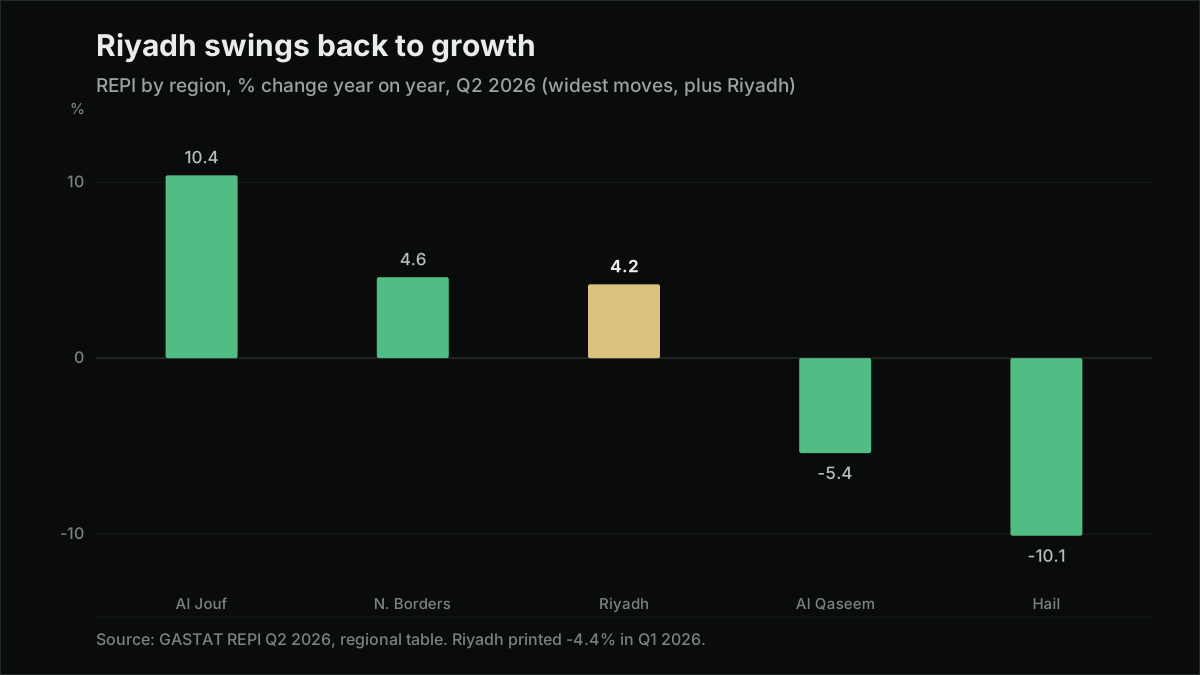
Riyadh property prices are rising again. GASTAT's index for the region was up 4.2% on a year earlier in Q2 2026, after a 4.4% fall in Q1 (GASTAT REPI, Q2 2026). That turnaround came ten months into a five-year rent freeze.
The region is home to about 8.59 million people on the 2022 census (RCRC Open Data). In June 2026 it recorded sales worth SR8.04 billion (REGA, via Arab News).
Key figures at a glance
| Metric | Value | Scope | As of | Source |
|---|---|---|---|---|
| Price index (REPI), Riyadh | +4.2% YoY, +5.6% QoQ (from -4.4% YoY in Q1) | Riyadh region, all property | Q2 2026 | GASTAT |
| Population | 7,009,120 governorate; 8,591,748 region | 2022 census | 2022 | RCRC Open Data |
| Sales | 5,437 deals, SR8.04bn (33.97% of national value) | Riyadh region | Jun 2026 | REGA via Arab News |
| Rental transactions | 127,804, worth SR3.79bn | Riyadh region | Jun 2026 | REGA via Arab News |
| Metro ridership | 200 million cumulative | all 6 lines, since Dec 2024 | Mar 2026 | RCRC |
| Rent freeze | 5 years, residential + commercial | Riyadh urban boundary | from 25 Sep 2025 | REGA |
| National rent inflation | +4.4% YoY, largest CPI driver | KSA, actual rents | Jun 2026 | GASTAT via Arab News |
Prices turned in a single quarter
The Riyadh index stood at 115.98 points in Q2 2026. That is 4.2% up on the year and 5.6% up on the quarter, ending a dip that lasted two quarters (GASTAT REPI Q2 2026).
Growth was 3.6% in Q2 2025 and 1.0% in Q3 2025 (GASTAT RPI Q3 2025). The index then fell 3.0% in Q4 2025 (GASTAT via Argaam) and 4.4% in Q1 2026 (GASTAT via Arab News). The rent freeze arrived on 25 September 2025, close to the top of that slide, and sale prices have since recovered.
Nationally, residential plots were up 6.3% in the year to Q2 2026 while villas fell 9.7% (GASTAT).
We read that as buyers paying up for serviced land and marking down existing villas, which is what happens when land is the scarce input. The national picture is in our Saudi residential market review.
National transaction value halved in H1 2026, to SR82.2 billion from SR169.4 billion. The average price per square metre slipped only about 11%, to SR1,965 from SR2,217. Riyadh's move to the parcel-based Real Estate Registry also changed what those counts include (Ministry of Justice data, via Arab News).
By June, activity was picking up. National residential sales reached 19,844, up 18% on a year earlier (REGA, via Arab News).
The index and the raw average can disagree. The REPI is quality-adjusted, built with REGA, Ministry of Justice and SAMA data on a 2023 base (GASTAT methodology bulletin). An average moves with the mix of what sold, while the index tracks repricing.
What is driving housing demand in Riyadh
More than a quarter of the Kingdom's population lived in the Riyadh region at the 2022 census (RCRC Open Data).
The Riyadh Metro opened in early December 2024 and carried its 100 millionth passenger in under nine months (RCRC, via SPA, Aug 2025). It passed 200 million on 14 March 2026, with the Blue Line along Olaya taking 45% of riders (RCRC). No public body yet publishes price effects by station.
Bank real-estate loans reached SAR 970.9 billion by Q1 2026, or 28.9% of all bank credit (SAMA). Household lending is covered in our Saudi mortgage market analysis, and the headquarters influx in our Riyadh office market piece.
Is there a housing shortage in Riyadh?
No ministry publishes a Riyadh housing deficit. The figure often quoted, 60,000 to 80,000 units a year, has no primary government source we can find, so we leave it out. The strain shows up in rents instead.
Al-Eqtisadiah, working from GASTAT data, put the rise in average Riyadh household rents at about 60% between 2021 and end-2024 (Al-Eqtisadiah, Mar 2025). Nationally, rents rose 10.6% in 2024 (GASTAT Annual CPI 2024) and 8.2% in 2025 (GASTAT, via GCC Business Watch).
The government responded with a freeze. From 25 September 2025, Riyadh landlords cannot raise rents on residential or commercial contracts for five years. Re-lets are priced at the last registered Ejar value (REGA). The rules and penalties are on our Riyadh rent freeze page.
National rent inflation has eased since. It was 6.7% in September 2025 (GASTAT CPI). By June 2026 it was 4.4%, still the biggest driver of Saudi inflation (via Arab News). The series is national and the freeze covers only Riyadh, so it gives context but does not prove the freeze works.
What is being built
NHC's Khuzam scheme in north Riyadh is planned for more than 52,000 units. It opens with Taraf, a 2,000-unit villa and townhouse project (NHC, via SPA, 15 Jan 2026). Eleven more Khuzam projects launched on 15 May 2026 (Business Today ME).
ROSHN, the PIF-owned developer within the giga-project group, is building 30,000+ homes at Sedra across 20 million sqm, with a first phase of 4,500 (ROSHN, via TradeArabia). It also has 2,380 homes at Warefa in east Riyadh (ROSHN).
Riyadh took 19% of national Sakani housing contracts in February 2026, the highest of any region (MOMAH).
Masterplans take years to turn into finished homes. A 52,000-unit scheme announced in January 2026 will not change supply between 2026 and 2028. Riyadh housing stock figures in circulation come from private consultancies, so we have not used them.
What the freeze does to yields
Omran estimate. Buy a tenanted Riyadh apartment today and the rent is fixed until 25 September 2030. It cannot rise, and a re-let is capped at the last Ejar value (REGA). Prices are not fixed, though: if values kept rising at the Q2 2026 pace of 4.2% a year (GASTAT) until the freeze ends, just over four years away, they would grow by some 19% while the rent stays flat. A 6.0% gross yield at today's price would then fall to roughly 5.0%. Treat it as an illustration. It may also explain why money has moved towards land and owner-occupation, which the freeze does not cover.
No authority publishes a Riyadh yield, so the 6.0% starting point is derived from two REGA series, explained on rental yield in Saudi Arabia.
The rent side of that sum is now published. REGA's Riyadh rental indicator gives a transaction count for each district and unit type, and we cover it on average rent in Riyadh.
Other data is still missing as of July 2026. There is no public count of Riyadh's housing stock, completions or vacancy, and no figures on compliance with the freeze. We mark those n/a rather than borrow private survey numbers. Request the Riyadh residential dataset, or book a briefing on your own assumptions.
FAQ
Is the Riyadh real estate market going up or down in 2026? Up, as of Q2 2026, after two quarters of decline (GASTAT REPI).
Why are property prices in Riyadh rising despite the rent freeze? The freeze only caps lease increases. Sale prices follow demand and credit, and both have held up. Capped rents may even push money towards land and ownership.
Is there a housing shortage in Riyadh? No official deficit number exists, and the "60,000 to 80,000 units a year" figure circulating has no traceable primary source. The published evidence of strain is rent: around +60% cumulative from 2021 to end-2024 per Al-Eqtisadiah on GASTAT data, answered by a Royal Decree freezing rents for five years from 25 September 2025.
What is the average rent in Riyadh? REGA's rental indicator for Riyadh city puts average annual apartment rent at SAR 28,324 in Q4 2024, about SAR 2,360 a month. That figure rests on 176,769 registered rental transactions (REGA rental indicators, KSA Open Data Licence). The number of registered leases grew roughly 5.8 times between 2019 and 2024, so the flat stretch from 2019 to 2021 partly reflects Ejar coverage catching up. The district and unit-type breakdown, and that caveat in full, sit on average rent in Riyadh.
Sources
- GASTAT, Real Estate Price Index Q2 2026 (Riyadh +4.2% YoY, +5.6% QoQ; sector splits): link
- GASTAT via Arab News, REPI Q1 2026 (Riyadh -4.4% YoY): link
- GASTAT via Argaam, REPI Q4 2025 (Riyadh -3.0%, index 109.88): link
- GASTAT, RPI Q3 2025 (Riyadh +1.0% vs +3.6% in Q2 2025): link
- GASTAT, REPI methodology bulletin (Geo-AI, 2023 base): link
- RCRC Open Data Portal, 2022 census population (governorate, region, national): link
- REGA monthly market report via Arab News, June 2026 (Riyadh sales, rentals; national residential sales): link
- Ministry of Justice data via Arab News, H1 2026 transactions (-51.5% value; price per sqm): link
- REGA, Riyadh five-year rent freeze provisions (25 Sep 2025): link
- RCRC, Riyadh Metro 200 million passengers (Mar 2026): link
- RCRC via SPA, Riyadh Metro 100 million riders in under nine months (Aug 2025): link
- PIF via Arab News, Expo 2030 Riyadh Company ($64bn GDP, 171,000 jobs, 6M sqm): link
- SAMA, Key Economic Developments Q1 2026 (real-estate loans SAR 970.9bn): link
- Al-Eqtisadiah (citing GASTAT), Riyadh rents +60% since 2021: link
- GASTAT, Annual Average CPI 2024 (rents +10.6%): link
- GASTAT via GCC Business Watch, 2025 annual rents +8.2%: link
- GASTAT, CPI September 2025 (rents +6.7%): link
- GASTAT via Arab News, CPI February 2026 (rents +5.1%): link
- GASTAT via Arab News, CPI June 2026 (rents +4.4%): link
- NHC via SPA, Khuzam destination and Taraf project (Jan 2026): link
- Business Today ME, NHC's 11 Khuzam project launches (15 May 2026, per Saudi Exchange announcements): link
- ROSHN via TradeArabia, Sedra (30,000+ homes, 20M sqm): link
- ROSHN, Warefa community (2,380 homes): link
- MOMAH, Sakani regional shares February 2026 (Riyadh 19%): link
- MOMAH via Saudi Gazette, Sakani first five months of 2026 (51,072 first homes): link