Saudi mortgage lending falls 12% despite rate cuts
Saudi banks wrote SAR 80.4 billion of new home loans in 2025, 12% less than in 2024. Villas still take most of the money, and lower rates have not brought buyers back.
Saudi banks wrote SAR 80.4 billion of new home loans in 2025, 12% less than the year before (SAMA data via Argaam, 3 Feb 2026). That covers 108,800 contracts, and villas took 64% of the money.
The monthly numbers look worse. Banks lent SAR 4.47 billion in November 2025, less than half the SAR 10.06 billion of November 2024 (SAMA Monthly Statistical Bulletin, Nov 2025). This happened while the central bank cut its policy rate by 175 basis points between mid-2024 and December 2025.
Key figures at a glance
| Metric | Value | Scope | As of | Source |
|---|---|---|---|---|
| New residential mortgages, banks | SAR 80.42bn, down 12% YoY, 108,800 contracts | National | FY2025 | SAMA via Argaam |
| Villa share of bank mortgage value | 64% (SAR 51.4bn) | Banks | FY2025 | SAMA via Argaam |
| November 2025 monthly print | SAR 4.47bn (vs SAR 10.06bn Nov-2024) | Banks | Nov 2025 | SAMA Table 12f |
| New mortgages, finance companies | SAR 2.49bn, lowest in seven years | Non-bank lenders | FY2025 | SAMA via Argaam |
| Outstanding bank real-estate loans | SAR 938.0bn (retail + corporate) | Banks | Q3 2025 | SAMA Table 12e |
| SAMA repo rate | 4.25% (from 6.00% in mid-2024) | Policy rate | 11 Dec 2025 | Saudi Gazette |
| Average new bank mortgage | SAR 739,000, down 1% YoY | Banks | FY2025 | SAMA via Argaam |
| SRC international sukuk programme | USD 10bn (raised from 5bn) | Funding backbone | Jul 2026 | Arab News |
A market barely half its 2021 size
New bank mortgage lending peaked at SAR 152.5 billion in 2021, across 201,481 contracts. It fell to SAR 77.7 billion in 2023 and recovered to SAR 91.1 billion in 2024 (SAMA Table 12f, Nov 2025). The 2025 total of SAR 80.4 billion is 53% of the peak.
Contract numbers tell the same story. Banks signed 108,800 in 2025, against 225,073 in 2020, a fall of 52% in five years.
Finance companies are a footnote. They wrote SAR 2.49 billion in 2025, down 3% and their lowest in seven years (SAMA via Argaam). Banks and finance companies together lent about SAR 82.9 billion, against SAR 93.6 billion in 2024 (SAMA via Amlak, Feb 2026). This is a bank market.
Why does lending keep falling while the wider Saudi residential market still shows rent growth? We think the subsidised wave of first-time buyers is largely spent. Homeownership among Saudi families reached 66.24% by end-2025, up from 47% in 2016, close to the 70% Vision 2030 target (Minister Al-Hogail via Zawya, Jul 2026). What is left is an ordinary market, and buyers in it watch prices.
The monthly table shows demand first
SAMA's monthly Table 12f is the quickest free read on housing demand. Bank lending was SAR 10.46 billion in January 2025. By June it was SAR 5.32 billion, and by November SAR 4.47 billion (SAMA Table 12f, Nov 2025).
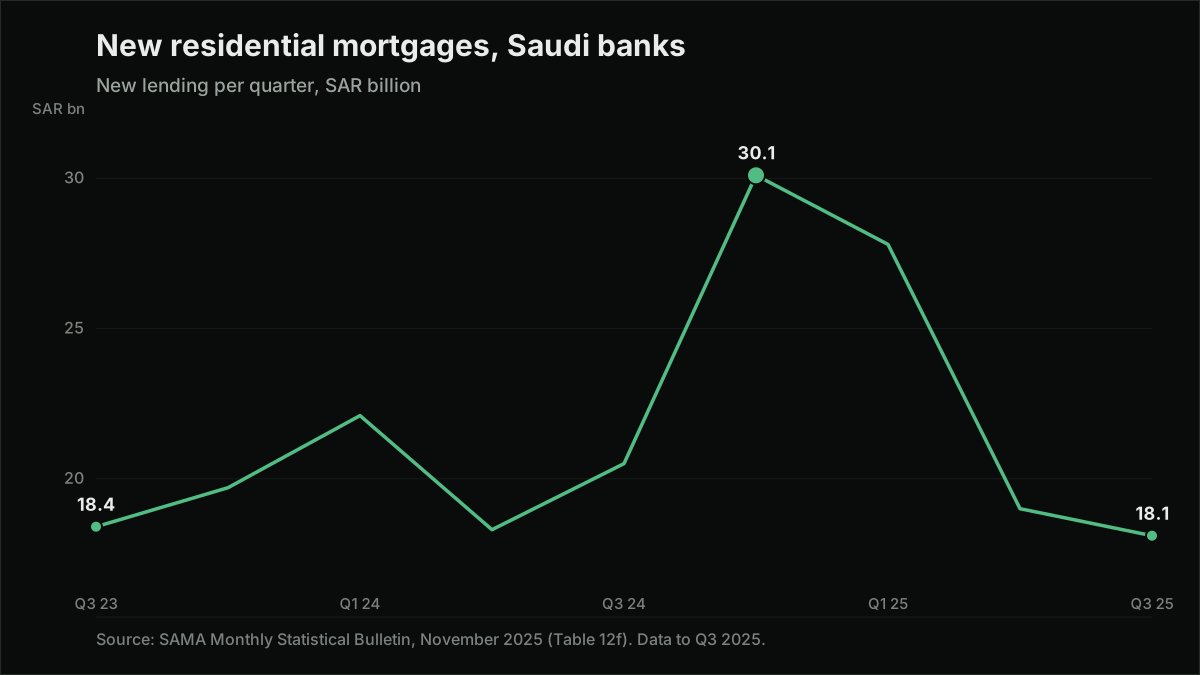
The annual figure hides when the drop happened. Lending from January to October 2025 was up 1.66% year on year, at SAR 72.37 billion (SAMA via Amlak, Nov 2025). The full year still fell 12% because the comparison quarter was strong. Q4 2024, at SAR 30.1 billion, was the best quarter since the current series began in Q3 2023 (SAMA Table 12f, same bulletin), and late 2025 fell well short of it.
The early 2026 signs are weaker still. Ministry of Justice data show transaction value down 51.5% year on year in H1 2026, at SAR 82.2 billion (MOJ via Arab News, 6 Jul 2026). About 29,000 homes sold in Q1 2026, down 50%, and March alone was down 62% (MoJ via AGBI, 12 May 2026). Mortgage lending tends to follow sales.
Villas still take most of the money
Villas took SAR 51.4 billion of bank mortgage lending in 2025, or 64%. Apartments took SAR 24.3 billion and land SAR 4.7 billion (SAMA via Argaam, Feb 2026).
Villa lending peaked at SAR 96.19 billion in 2021 and has roughly halved since. Apartment lending peaked later, at SAR 28.09 billion in 2024 (SAMA via Amlak, Feb 2026).
The shift is clearer in contract counts. In 2020, apartments were 21,915 of 225,073 bank mortgage contracts, under 10%. In 2024 they were 28,085 of 122,302, roughly 23% (SAMA Table 12f). Mortgaged land purchases have almost gone, from 35,609 contracts in 2020 to 4,677 in 2024 (same table). That fall started before the current white land fee schedule.
Prices point the other way. GASTAT's Q2 2026 index shows villa prices down 9.7% year on year, while apartments rose 1.1% (GASTAT REPI, Q2 2026). So two-thirds of mortgage money still goes into villas, the weakest-priced home type in the Kingdom. With the average loan at SAR 739,000, many villas no longer fit the budget, and buyers are moving to apartments. For where they are buying, see the Riyadh residential market.
What Saudi mortgages are priced off
SAMA's repo rate went from 6.00% in mid-2024 to 5.00% on 18 December 2024 (SPA). It came down further through 2025 and reached 4.25% on 11 December 2025 (Saudi Gazette). The reverse repo has stayed at 3.75% through June 2026 (Trading Economics, citing SAMA).
Three-month SAIBOR, the interbank rate banks lend off, averaged 6.02% in 2024. It was 4.97% in November 2025 (SAMA Table 6, Nov-2025 bulletin).
Those 175 basis points of cuts did not bring lending back. Monthly lending fell right through the cutting cycle. Subsidies held up too: the Real Estate Development Fund paid roughly SAR 12.4 billion into beneficiary accounts in 2025 (REDF via ArchUp). In our view, prices and eligibility are now holding buyers back more than the cost of credit.
The loan book keeps growing
New lending is shrinking, but the stock of loans is not. Outstanding bank real-estate loans grew from SAR 428.4 billion at end-2020 to SAR 883.3 billion at end-2024, and SAR 938.0 billion by Q3 2025 (SAMA Table 12e, Nov-2025 bulletin). That is 6.2% growth in nine months of a weak year. Mortgages run for decades and most of this book is recent, so it will keep growing for a while.
Omran estimate (SAMA-derived). SAMA publishes bank and finance-company loan books in separate tables, with no combined total. Adding Table 12e (SAR 937,998 million, banks) and Table 4 (SAR 28,772 million, finance companies) from the same Nov-2025 bulletin gives total outstanding real-estate finance of SAR 966.8 billion at end-Q3 2025.
Funding behind that book is growing fast. The Saudi Real Estate Refinance Company (SRC) is owned by PIF and buys mortgage portfolios from lenders. It sold its first government-guaranteed international sukuk, USD 2 billion, in February 2025, six times oversubscribed (SPA). A second, USD 2.5 billion, followed in September 2025, 5.5 times oversubscribed (SPA). The third, USD 2.75 billion in July 2026, was 6.8 times oversubscribed, and the programme ceiling went from USD 5 billion to USD 10 billion (Arab News).
SRC also launched the Kingdom's first residential mortgage-backed securities in August 2025. No source gives the size of the deal, so we show it as n/a (Arab News).
SRC had SAR 38.3 billion of assets at Q3 2025 (SAMA Table 1, same bulletin). That is about 4% of the bank real-estate book (38,325 / 937,998). Foreign investors are keen to buy Saudi mortgage paper, more so for now than Saudi households are to take out new loans.
Five numbers SAMA does not publish
These tables are the best free mortgage data in the Gulf. They still leave a lender guessing on five points:
- The mortgage rate banks charge. SAMA publishes the repo rate and SAIBOR, not the margin banks add. Bank product pages are inconsistent.
- Loan-to-value and loan term. No official average is published.
- Borrower nationality. The series never splits Saudi from expatriate borrowers.
- SRC's total refinanced portfolio. Each sukuk size is public, the total book is not.
- The RMBS pool size. Launched, size n/a.
We track the SAMA, MOJ, REDF and SRC releases every month and line them up in one dated series, alongside the rest of the Saudi data sources. Request the underlying mortgage table, or ask us for a briefing on your own product mix.
FAQ
What is the current mortgage rate in Saudi Arabia? No official body publishes the retail rate banks charge. The anchors are public: SAMA's repo rate has been 4.25% since 11 December 2025 (Saudi Gazette) and three-month SAIBOR was 4.97% in November 2025 (SAMA). Banks price above those benchmarks, and quotes vary by lender and loan term.
Is there mortgage financing available in Saudi Arabia? Yes. Banks and finance companies wrote about SAR 82.9 billion of new residential mortgages in 2025, and the average new bank mortgage was SAR 739,000 (SAMA via Amlak).
Can expats get a home loan in Saudi Arabia? Banks market home-finance products to residents, but SAMA's published series never splits borrowers by nationality, so there is no official figure for expat lending. Each bank sets its own eligibility rules. The subsidised REDF pathway serves Saudi families. On the ownership side, the rules changed recently; see foreign property ownership in Saudi Arabia.
What is the Saudi Real Estate Refinance Company (SRC)? SRC is the PIF-owned company that buys and refinances mortgage portfolios from Saudi lenders. It has issued three government-guaranteed international sukuk totalling USD 7.25 billion since February 2025 under a programme now sized at USD 10 billion (Arab News, Jul 2026), and launched Saudi Arabia's first RMBS in August 2025.
What is the REDF housing subsidy? The Real Estate Development Fund deposits support payments into eligible beneficiaries' accounts under the Housing Support Program: roughly SAR 12.4 billion across 2025 (REDF via ArchUp). More than 122,000 families received housing support during 2024 (MOMAH).
Sources
- SAMA Monthly Statistical Bulletin, Nov 2025 (Tables 12f, 12e, 7, 4, 6, 1: mortgage flow, loan stock, rates, SRC balance sheet): link
- Argaam, FY2025 new residential mortgages citing SAMA (SAR 80.4bn, villa share, SAR 739k average): link
- Amlak Newspaper, FY2025 combined lending and product peaks citing SAMA: link
- Amlak Newspaper, Jan-Oct 2025 cumulative lending citing SAMA: link
- SPA, SAMA repo cut to 5.00% (18 Dec 2024): link
- Saudi Gazette, SAMA repo cut to 4.25% (11 Dec 2025): link
- Trading Economics, reverse repo at 3.75% through Jun 2026, citing SAMA: link
- SPA, SRC first international sukuk (USD 2bn, Feb 2025): link
- SPA, SRC second international sukuk (USD 2.5bn, Sep 2025): link
- Arab News, SRC third international sukuk and USD 10bn programme (Jul 2026): link
- Arab News, SRC first RMBS launch (Aug 2025): link
- Arab News, MOJ H1 2026 transaction data: link
- AGBI, Q1 2026 home sales citing Ministry of Justice: link
- GASTAT, Real Estate Price Index Q2 2026 (villa and apartment sub-indices): link
- MOMAH, Housing Program Annual Report 2024 (122,000 families supported): link
- Zawya (Saudi Gazette byline), homeownership 66.24% at end-2025: link
- ArchUp, REDF Housing Support Program deposits, citing REDF/SPA: link