Saudi property prices rise again as deal values halve
Saudi property prices rose 1.3% in Q2 2026, even as the value of deals halved to SAR 82.2bn, mostly because land trading dried up.
Saudi property prices are rising again, but far fewer deals are being done. GASTAT's official index rose 1.3% a year in Q2 2026, after a 1.6% fall in Q1. Over the same half-year, the value of property changing hands halved to SAR 82.2 billion, according to Ministry of Justice data.
Land speculators are being taxed out of the market. Buyers who borrow to buy a home are still there, and they now set the price for most of what trades.
This page covers the national picture. For city detail, start with the Riyadh residential market.
Key figures at a glance
| Metric | Value | Scope | As of | Source |
|---|---|---|---|---|
| Real Estate Price Index, all sectors | +1.3% YoY, after -1.6% in Q1 | Kingdom-wide | Q2 2026 | GASTAT |
| REPI residential sector | +2.6% YoY (villas -9.7%, plots +6.3%) | Kingdom-wide | Q2 2026 | GASTAT |
| Real estate transaction value | SAR 82.2bn, down 51.5% YoY | Kingdom-wide | H1 2026 | MOJ via Arab News |
| Number of transactions | 161,900, from 220,000 (-26.4%) | Kingdom-wide | H1 2026 | MOJ via Arab News |
| Average price paid, all property | SAR 1,965 per sqm, from SAR 2,217 (-11.4%) | Kingdom-wide | H1 2026 | MOJ via Arab News |
| Land transactions | 21,320, down 55% YoY | Kingdom-wide | Q1 2026 | REGA via AGBI |
| Land transaction value | SAR 20.71bn, down 65% YoY | Kingdom-wide | Q1 2026 | REGA via AGBI |
| Villa transactions | just over 3,500 (-44%) | Kingdom-wide | Q1 2026 | REGA via AGBI |
| Apartment transactions | 12,650 (-38%) | Kingdom-wide | Q1 2026 | REGA via AGBI |
| New residential mortgage lending | SAR 82.9bn (from SAR 93.6bn in 2024) | Banks + finance companies | FY2025 | SAMA via Amlak |
| Homeownership rate | 66.24% (Vision 2030 target: 70%) | Saudi families | end-2025 | MOMAH via Saudi Gazette |
| White land fee | 2.5% to 10% of land value, annual | Priority zones, holdings >=5,000 sqm | invoicing from 1 Jan 2026 (Riyadh) | MOMAH |
| Actual housing rents (CPI) | +4.7% YoY | Kingdom-wide | May 2026 | GASTAT via Arab News |
Prices turned positive in Q2 2026
GASTAT's Real Estate Price Index rose 1.3% year on year in Q2 2026, against -1.6% in Q1 2026 (GASTAT REPI Q2 2026; Q1 2026 bulletin).
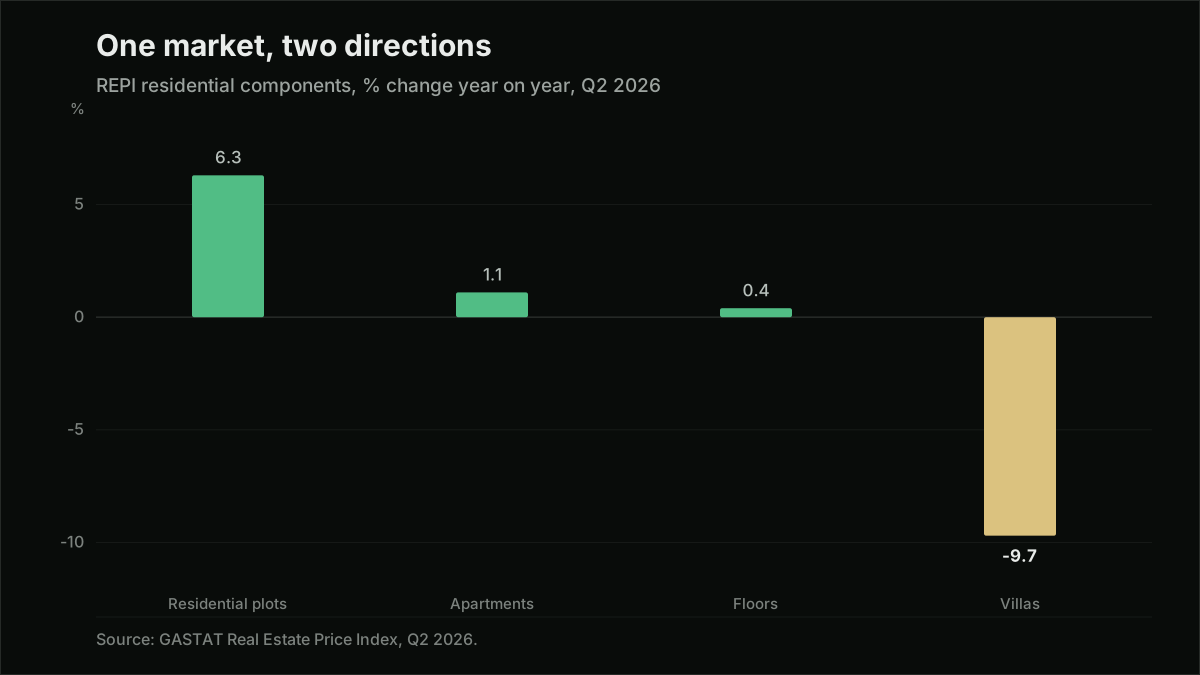
Residential property, 72.7% of the index, rose 2.6%. Plots, which families buy to build their own house, led with a 6.3% rise, while villas fell 9.7%, steeper than the -6.1% of Q1. Apartments and residential floors barely moved, at 1.1% and 0.4%.
The biggest swing was in Riyadh, where the policy pressure is heaviest: from -4.4% in Q1 to +4.2% in Q2 (GASTAT, regional sheet).
Deal values halved, prices barely moved
Ministry of Justice data puts H1 2026 deal value at SAR 82.2 billion, down 51.5% on a year earlier (MOJ via Arab News, Jul 2026). The number of deals fell about half as much.
When value falls twice as fast as volume, the big tickets have gone first. In REGA's Q1 2026 figures, land deals fell 55%, the lowest quarter in a series going back to mid-2023. Apartments held up best (REGA via AGBI, Jul 2026).
Building permits rose 28% in April 2026, as more families build their own homes (AGBI). That fits the rise in plot prices.
The 11.4% fall in the MOJ average price often gets quoted as a crash. Most of it is mix: when expensive land deals drop out, the average falls with them. GASTAT's index compares like with like (GASTAT methodology), which is why we use it for prices.
Mortgage lending is holding the market up
New mortgages from banks alone came to SAR 80.4 billion in 2025, down 12%, across 108,800 contracts, with an average loan of SAR 739,000 (SAMA via Argaam, 3 Feb 2026). That is well below the SAR 152.5 billion peak of 2021 (SAMA Monthly Statistical Bulletin, Nov 2025).
Lending fell 12% while deal values halved. Salaried households with a mortgage are still buying. It is the cash land traders who have stepped back. Villas took 64% of bank mortgage value in 2025 (SAMA via Amlak), so many of these buyers are paying for a product whose price is falling, and can negotiate accordingly.
SAMA cut its repo rate through 2025, which has helped (Saudi Gazette). The full lending series is in our Saudi mortgage market analysis.
Policy: land fees, a rent freeze and new buyers
The amended White Land law replaced the flat 2.5% fee with four annual tiers, up to 10% of land value in top-priority zones, for owners holding 5,000 sqm or more in a city (MOMAH; Amlak). Riyadh billing started on 1 January 2026, with more than 60,000 invoices (MOMAH via AGBI, 2 Jan 2026). By mid-June, MOMAH said 71 million sqm of idle Riyadh land was being developed or traded (MOMAH via Amlak, 17 Jun 2026).
A second fee of up to 5% now applies to buildings left empty for six months or more (MOMAH via Saudi Gazette). Rates and timeline are in our white land tax briefing.
Riyadh rents were frozen for five years from 25 September 2025 (King & Spalding, on the royal decree). See how the rent freeze works.
Homeownership among Saudi families reached 66.24% at end-2025, up from 47% in 2016, against a Vision 2030 target of 70% (MOMAH via Saudi Gazette). Foreign buyers are also being let into set zones: see can foreigners buy property in Saudi Arabia.
Rents keep rising
GASTAT's CPI shows housing rents up 4.7% a year in May 2026, the largest contributor to headline inflation of 1.8% (GASTAT via Arab News, Jun 2026).
Omran note on yields. No official source publishes Saudi residential yields, but the direction is clear. Rents are up 4.7%, while apartment prices are up 1.1% and villa prices down 9.7%. Gross yields on existing homes are rising, fastest on villas.
What the official data doesn't publish
No Saudi government body publishes average sale prices by city, a national pipeline of new units, rental yields, or absorption (how fast new stock sells; see absorption rate explained). We publish labelled estimates from the official record instead, per our methodology.
Omran estimate (from REGA data): land deals are getting smaller. REGA's Q1 2026 land value divided by the number of deals gives roughly SAR 971,000 per deal. Working back from the published falls, the figure a year earlier was near SAR 1.25 million, a drop of roughly 22%. The fees are pushing out large speculative plots faster than they cut the number of deals.
Over the next four quarters, the question is whether that land turns into new homes quickly enough for the mortgage buyers still in the market. Our project-level data is available on request.
FAQ
Is the Saudi real estate market growing or falling in 2026? Prices are rising and activity is falling. The official index rose 1.3% in Q2 2026 while deal value halved in the first half.
Why did transaction values fall by half? Mostly land. Large plots stopped trading once Riyadh landowners started receiving white land fee bills.
What is the average house price in Saudi Arabia? No official body publishes one. SAMA's average new mortgage of SAR 739,000 in 2025 is the closest guide to what a financed home costs.
What is Saudi Arabia's homeownership rate? 66.24% of Saudi families at end-2025, short of the 70% Vision 2030 target.
What is the white land tax? An annual fee of 2.5% to 10% of land value on large undeveloped urban plots. Makkah, Jeddah and the Dammam area follow Riyadh in phase two.
What is the Saudi Real Estate Price Index (REPI)? GASTAT's official quarterly price index, rebuilt on a 2023 base with REGA, the Ministry of Justice and SAMA.
Sources
- GASTAT, Real Estate Price Index Q2 2026 (national +1.3%, residential detail, regions): link
- GASTAT, Real Estate Price Index Q1 2026 bulletin (-1.6% YoY, methodology): link
- Ministry of Justice H1 2026 transaction data, via Arab News: link
- REGA Q1 2026 land/villa/apartment transactions, via AGBI: link
- SAMA FY2025 mortgage lending (combined SAR 82.9bn), via Amlak Newspaper: link
- SAMA FY2025 bank mortgages (SAR 80.4bn, 108,800 contracts), via Argaam: link
- SAMA Monthly Statistical Bulletin, Nov 2025: link
- MOMAH homeownership 66.24% end-2025, via Saudi Gazette: link
- MOMAH, Riyadh white land fee tiers and 1 Jan 2026 invoicing: link
- White land fee tier schedule, via Amlak Newspaper: link
- MOMAH Riyadh white-land impact (71M sqm), via Amlak Newspaper: link
- MOMAH 60,000+ Riyadh invoices, via AGBI: link
- MOMAH vacant property fee regulations (up to 5%), via Saudi Gazette: link
- King & Spalding, Riyadh five-year rent freeze (25 Sep 2025 decree): link
- Saudi Gazette, SAMA repo rate cut (Dec 2025): link
- GASTAT CPI May 2026 (rents +4.7%), via Arab News: link