Saudi economic zone tax breaks now require an office and staff in the zone
Saudi Arabia has four special economic zones. Since August 2026 the tax break comes with a condition: real premises and staff inside the zone.
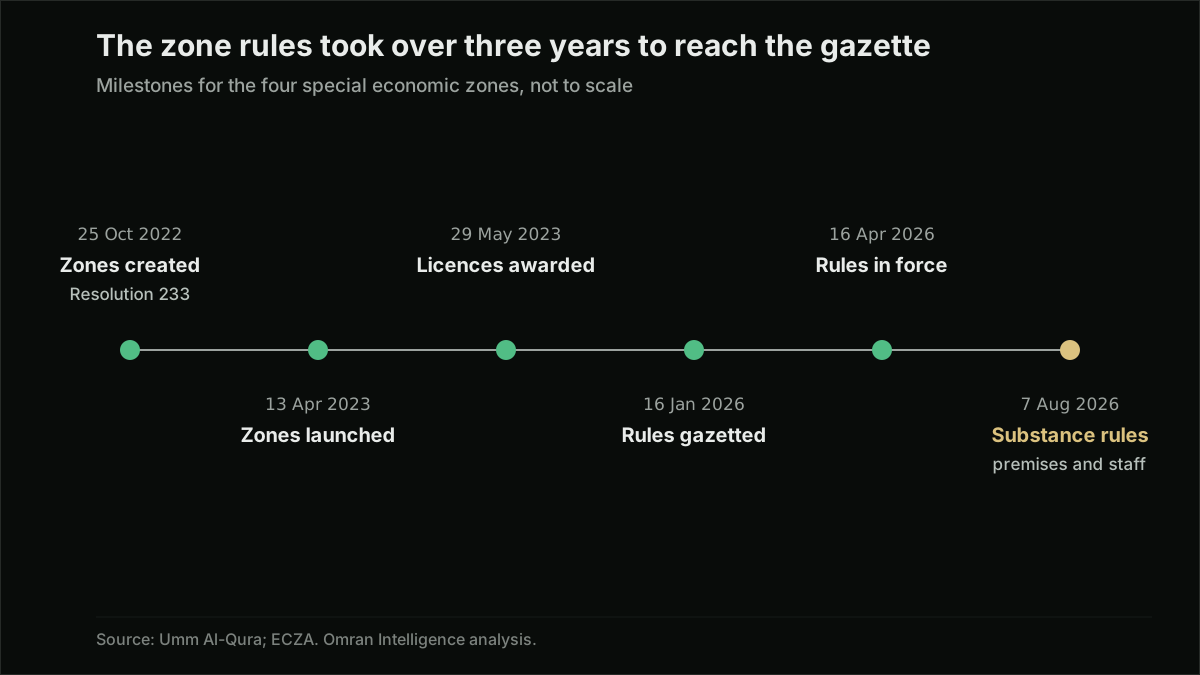
Saudi Arabia has four special economic zones, and since 7 August 2026 their tax break comes with a condition: the company has to be physically there. It needs premises in the zone, staff who work there and spending inside the zone, and it has to prove this every year. For anyone siting a plant at King Abdullah Economic City, Jazan or Ras Al-Khair, a tax decision is now also a property decision.
The zones cover 104.6 km² of designated land between the three physical ones (ECZA SEZ portal, read 30 Aug 2026). Their regulations took effect on 16 April 2026 (Umm Al-Qura), the substance rules on 7 August (Umm Al-Qura).
Four zones, one of them with no land
The zones were created by Cabinet Resolution 233 of 25 October 2022 and launched on 13 April 2023. Three are physical: King Abdullah Economic City (KAEC) on the Red Sea coast, Jazan in the south-west and Ras Al-Khair on the Gulf. The fourth, Cloud Computing, is virtual and covers data centres anywhere in the Kingdom.
ECZA's own 2023 brochure lists a fifth, the Riyadh Integrated Special Logistics Zone. That one runs under a separate 2018 royal decree and a different regulator, so we leave it out.
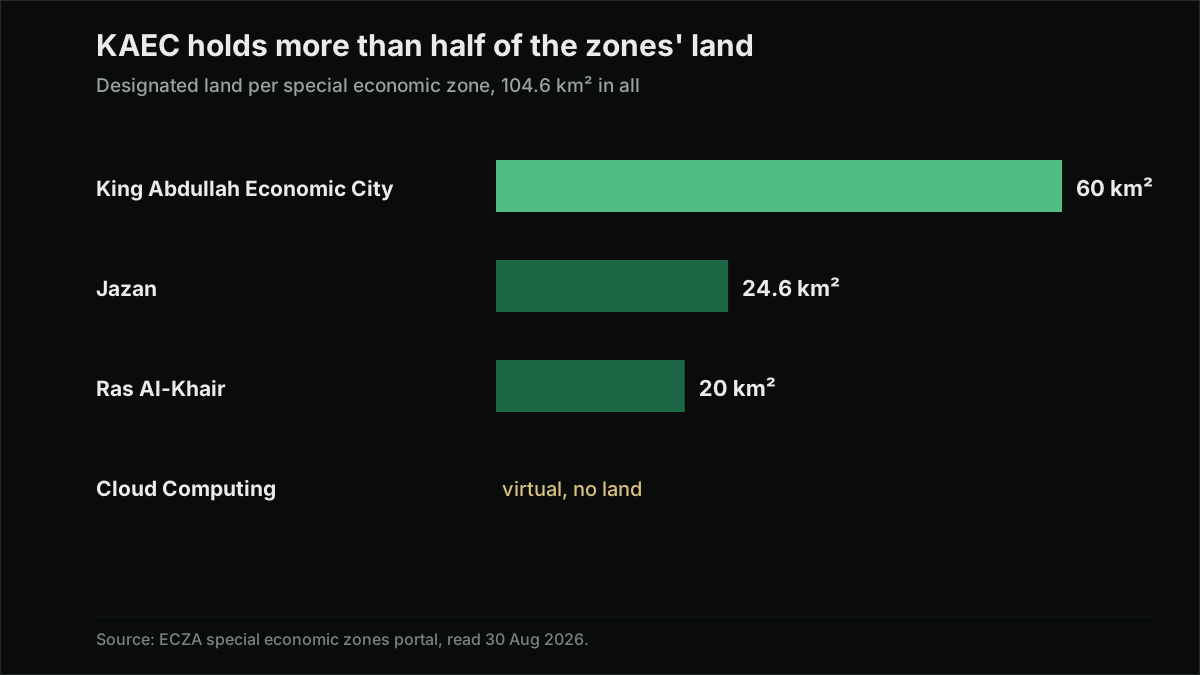
KAEC is run by Emaar, The Economic City, a listed company. Jazan and Ras Al-Khair sit with the Royal Commission for Jubail and Yanbu, which explains why both lean towards heavy industry. Ras Al-Khair, for instance, is built around shipbuilding and rig repair.
The 5% rate comes from a brochure
The four zone regulations were gazetted on 16 January 2026 and took effect on 16 April. All four say the licensed company pays income tax under the incentives of Resolution 233. None of them gives a rate, and Resolution 233 itself is not published.
The "5% for up to 20 years" figure that most advisers quote comes from ECZA's June 2023 brochure. ECZA's current portal no longer repeats it and talks instead of reductions that depend "on zone and sector". Until the resolution is out, we treat 5% as ECZA's marketing figure.
Since August, the tax break needs a building
The Economic Substance Requirements Regulations took effect the day they were published. A company claiming the incentives must have "adequate premises and assets" in the zone, full-time staff physically working there, operating spending inside the zone, at least one director resident in the Kingdom, and it must file an annual return with ZATCA.
There is no minimum floor area and no headcount floor. But zone companies already have to keep their head office inside the zone, so in practice a firm booking the reduced rate at KAEC, Jazan or Ras Al-Khair will be leasing or buying real space there and proving it each year.
Land inside a zone is still taxed like land outside
Property inside economic cities and zones is registered by ECZA itself rather than through the national registry, and title deeds are issued by a notary at the Authority. Non-Saudis can own there under rules separate from the general foreign ownership regime.
The four zone regulations say nothing about property, though. We searched them for the words that would cover land and tenure, including usufruct, and found nothing. So the 5% real estate transaction tax still applies to a plot bought inside a zone, and none of the texts adds an exemption.
What industrial land costs at KAEC
No zone publishes a land tariff or a warehouse rent. The only priced record is ECZA's own sales file, which we used to pull out industrial plots at KAEC: 103 sales between 2017 and 2024, with an overall median of SAR 300 per sqm. The yearly breakdown below stops at 2022.
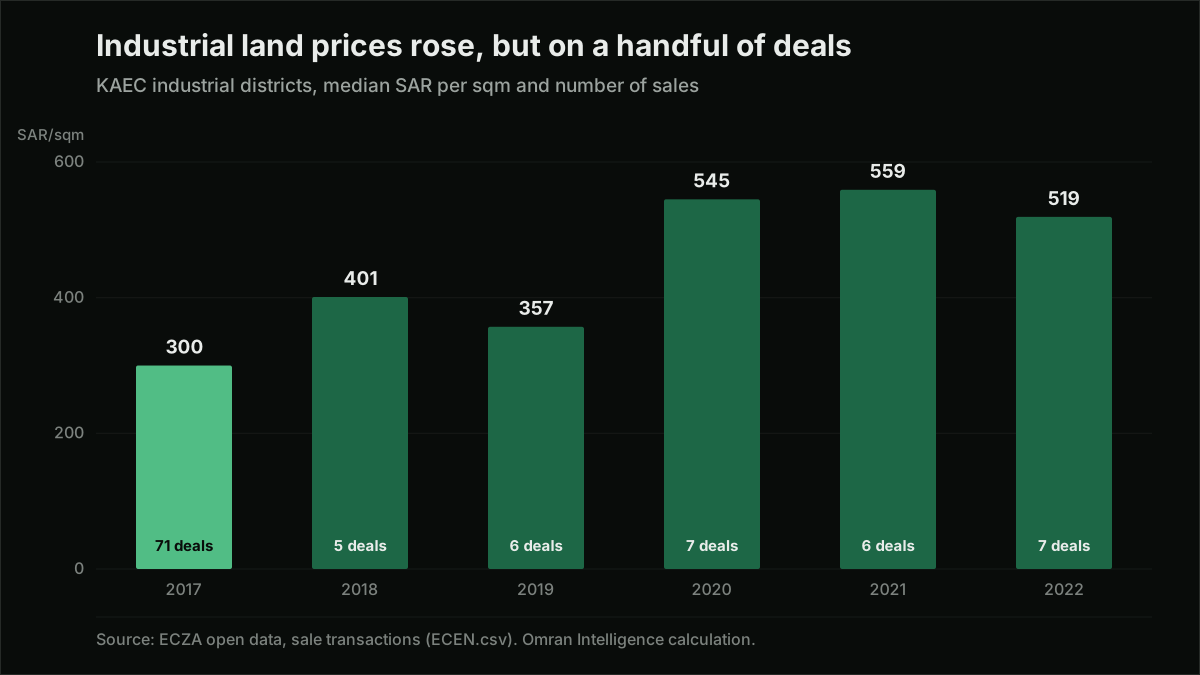
Only 2017 has a proper sample, with 71 sales, and its median happens to match the SAR 300 overall figure. Every later year rests on five to seven deals. From 2020 to 2022 the medians sat between roughly SAR 520 and 560, so the trend is up, though the samples are too small to price a plot on.
That matters for the arithmetic. At the older SAR 300/sqm a one-hectare plot costs SAR 3.0 million, and the transaction tax adds SAR 150,000. At the 2020-2022 medians the same plot comes to SAR 5.5 to 5.9 million with tax.
What is still missing
Resolution 233 and an official incentives guide have not been published. Until they are, the tax saving that the substance costs are meant to buy is an ECZA estimate, while the cost of an office and staff in the zone is real from the first year. We can share our zone-by-zone comparison.
Sources
- ECZA, launch of the four special economic zones (13 April 2023): link
- ECZA SEZ portal (zone footprints, sectors, current incentive wording): link
- ECZA brochure, June 2023 (advertised 5% rate, fifth zone): link
- Umm Al-Qura, Cabinet Resolution 468 approving the four zone regulations (16 January 2026): link
- Umm Al-Qura, the four zone regulations: KAEC, Jazan, Ras Al-Khair, Cloud Computing
- Umm Al-Qura, Economic Substance Requirements Regulations (7 August 2026): link
- ECZA Statute, official English translation (Articles 13 to 15): link
- ZATCA, Special Integrated Logistics Zone guideline, May 2026: link
- Umm Al-Qura, Real Estate Transaction Tax Law (5%, Article 2): link
- ECZA open data, economic-city sale transactions (ECEN.csv), Omran calculation: link