How many homes does Saudi Arabia actually have?
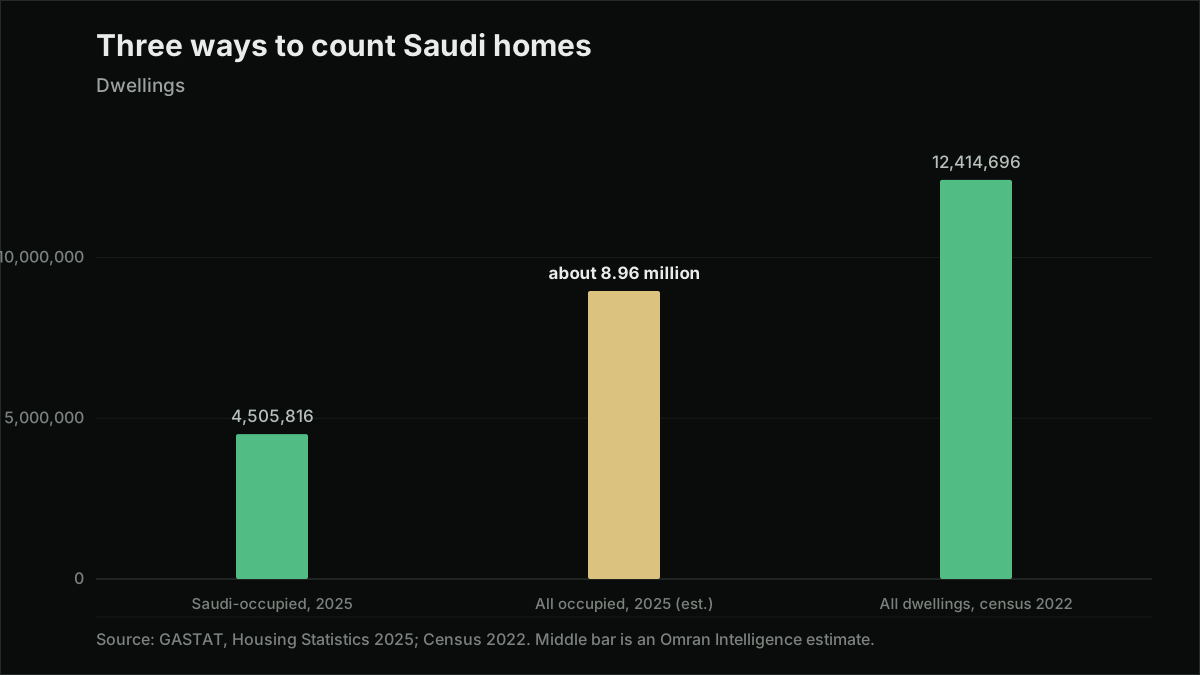
Saudi Arabia has about 8.96 million occupied homes, by our estimate from GASTAT data. The often-quoted 8.2 million is a count of households, so it leaves out every empty home.
Saudi Arabia has about 8.96 million occupied homes. That is our estimate from GASTAT figures, because the statistics office only publishes a full annual count for the homes Saudi families live in, which is about half of the total.
Key figures
| Figure | Value | Period | Source |
|---|---|---|---|
| Dwellings occupied by Saudi households | 4,505,816 | 2025 | GASTAT bulletin 2025 |
| Saudi share of occupied dwellings | 50.3% | 2025 | GASTAT publication 2025 |
| All occupied dwellings (Omran estimate) | about 8.96 million | 2025 | Omran Intelligence, from GASTAT |
| All dwellings counted in the census | 12,414,696 | 2022 | GASTAT / Census 2022 |
| Households (one per occupied home) | 8,174,674 | 2022 | GASTAT / Census 2022 |
| Saudi families who own their home | 65.4% | end-2024 | MOMAH |
How we get to 8.96 million
GASTAT's annual housing bulletin covers Saudi households only. In 2025 it counted 4,505,816 homes occupied by Saudi families, and its publication says they make up 50.3% of all occupied dwellings. Divide one by the other and the full occupied stock comes out at about 8.96 million.
The 2022 census gives a bigger number, 12,414,696, but that counts every class of dwelling, including commercial units and work camps.
Riyadh and Makkah hold almost half
Riyadh region and Makkah region have just over a million Saudi-occupied homes each, each close to a quarter, together almost half. GASTAT stops at region level, so there is no published count for Riyadh city or Jeddah. Makkah region puts Jeddah, Makkah and Taif in a single row.
Why 8.2 million is too low
The figure you see most often, 8.2 million homes, is the census count of households. The census found 8,174,674 households and exactly 8,174,674 residential dwellings, so each home on that list has a family in it. Using it as the housing stock assumes no home in the country is empty.
Where the empty homes might be
Vacant and unfinished homes sit in a census class GASTAT calls "other dwellings", 3,430,859 units. GASTAT's methodology says a dwelling can be "vacant, used for work, used as a collective dwelling, or under construction" (GASTAT methodology 2025), and the class is not split further. So nobody can derive a national vacancy rate from it, and reading it as 3.4 million empty homes would be wrong.
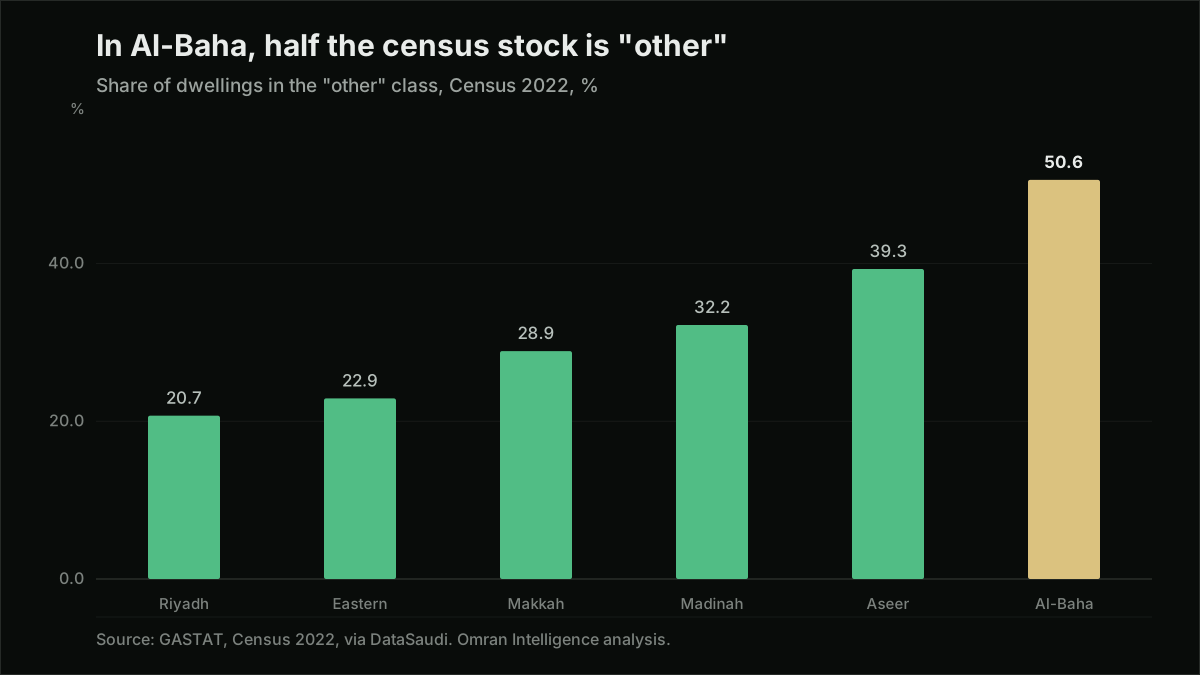
What it does show is a regional pattern. Al-Baha has 50.6% of its census stock in this class, against 20.7% in Riyadh. Most regions fall in between, from 22.9% in the Eastern Region through 28.9% in Makkah and 32.2% in Madinah to 39.3% in Aseer.
Home ownership did not drop after 2019
The 2022 census seems to show owner-occupancy falling from 62.08% in the 2019 survey to 55.18% (GASTAT release), but the drop comes from a new answer option. The census added an answer the survey never offered, "provided by a family member". Put those households back with the owners and 2022 lands at 62.65%, close to 2019.
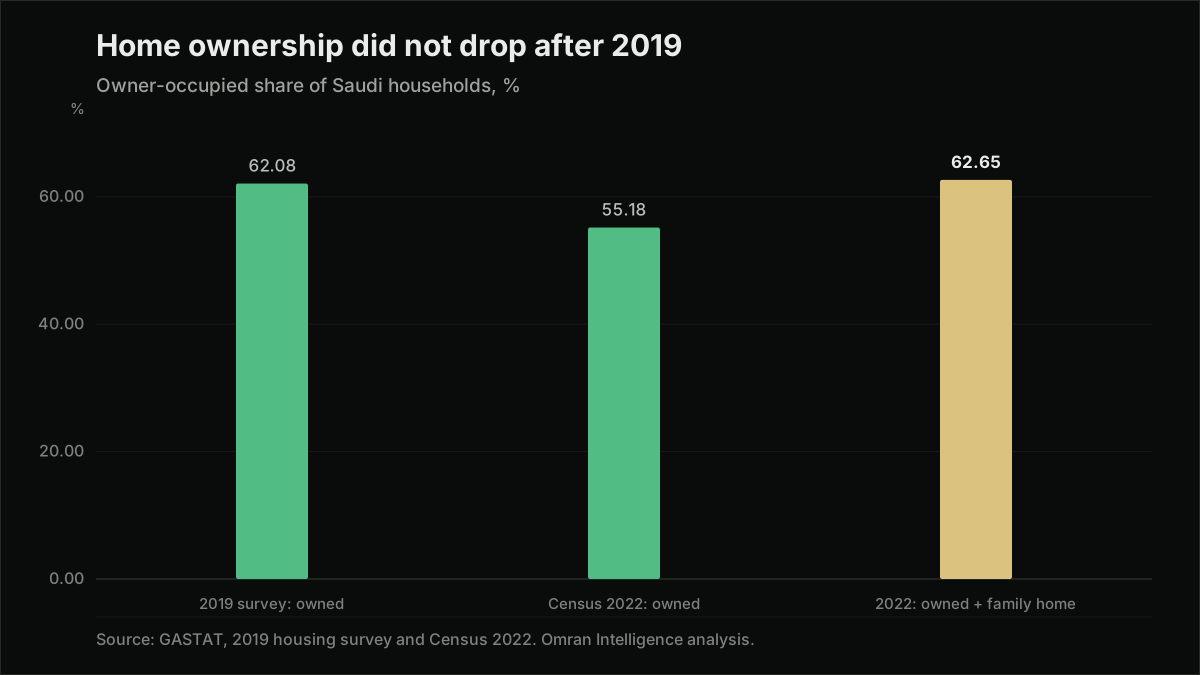
The Housing Programme reports a different measure, 65.4% of Saudi families at end-2024 against a 70% target for 2030 (MOMAH). GASTAT's own family report gives 60.6% for the census year (GASTAT). For a trend line, use the GASTAT series in the chart. Use the 65.4% only to track the 2030 target.
What to watch
Permits are not a good guide to new supply. GASTAT recorded 81,861 building permits in 2025 (GASTAT permits) while the Saudi-occupied stock alone grew by 118,585 homes. The two do not measure the same thing: one permit can cover a whole building, and the stock figure also moves when Saudi families move into homes that already existed. We will update the occupied estimate when GASTAT publishes its next housing figures. Our regional stock table has the figures by region. For prices and rents, see the Saudi residential market and rental yields.
Sources
- GASTAT, Housing Statistics Bulletin 2025 workbook: link
- GASTAT, Housing Statistics Publication 2025, EN (50.3% Saudi share): link
- GASTAT, Methodology and Quality Report for Housing Statistics 2025: link
- GASTAT / Census 2022, dwellings by class and by region (via DataSaudi): link
- GASTAT / Census 2022, households by nationality (via DataSaudi): link
- GASTAT, tenure series (via DataSaudi): link
- GASTAT, Arabic release on 2019 housing (62.08% owned): link
- GASTAT, Saudi Family Statistics Report (60.6%): link
- GASTAT, building permits (via DataSaudi): link
- Ministry of Municipalities and Housing, homeownership 65.4%: link