Saudi private property funds are now 12.3 times bigger than every listed REIT combined
Private real estate funds in Saudi Arabia held SAR 380.67bn at Q1 2026, more than any other private fund class, yet the regulator publishes only three numbers about them each quarter.
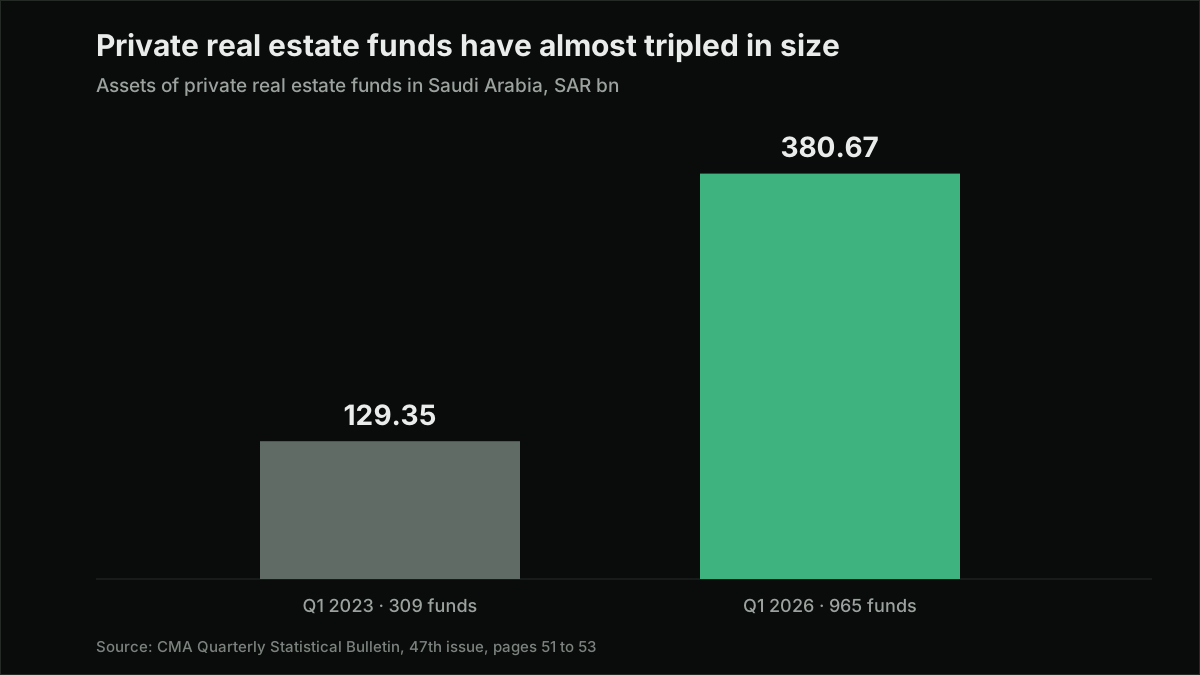
Saudi private real estate funds held SAR 380.67 billion at the end of Q1 2026 (CMA, Quarterly Statistical Bulletin, 47th issue, pages 51 to 53), far ahead of any other private fund class in the Kingdom.
The class has almost tripled in three years and now dwarfs the listed REITs. Yet the Capital Market Authority publishes only three totals a quarter about it: assets, the number of funds and the number of subscribers. Which funds they are, and what they own, stays private.
Key figures at a glance
| Metric | Value | Scope | As of | Source |
|---|---|---|---|---|
| Private real-estate fund AUM | SAR 380,674.64 million | Private "Real Estates" class, Kingdom-wide | Q1 2026 | CMA, p.51 |
| Funds and subscribers | 965 funds, 130,232 subscribers (309 and 56,113 at Q1 2023) | Same class | Q1 2026 | CMA, pp.52-53 |
| All private funds, every class | SAR 700,693.61 million across 1,788 funds | Private placements | Q1 2026 | CMA, pp.51-52 |
| Every listed REIT combined | SAR 30,838 million across 20 funds | Traded REITs | Q1 2026 | CMA, pp.44-45 |
| New capital raised by listed REITs | SAR 0.00 in both halves | Net subscriptions, public REIT class | 1H and 2H 2025 | CMA, p.56 |
| Private-placement notifications filed | 709, against one listed real-estate fund approved | Kingdom-wide | FY2025 | CMA, p.96 |
| Minimum size of a private real-estate fund | None. Part 5 sets no threshold | Investment Funds Regulations | as amended 24 Nov 2025 | CMA |
| Corporate real-estate credit at Saudi banks | SAR 227,389.94 million | Commercial banks, corporates only | Q1 2026 | SAMA, table 12e |
How big are private real estate funds in Saudi Arabia?
At Q1 2026 the class held SAR 380.67 billion across 965 funds. At Q1 2023 it was SAR 129.35 billion across 309 funds. Real estate is the biggest private class on every measure CMA publishes. Equities come next, with SAR 212,653.01 million in 222 funds (CMA, pp.51-52).
Private funds were 75.0% of all investment-fund assets at end-2025. The chairman puts the growth down to "a significant rise in private real estate fund assets, which grew by 53% to reach SAR 356 billion" (Annual Report 2025, pages 16 and 100).
Omran computation, from CMA's own figures. Real estate is 54.3% of all private-fund assets, and these funds hold 12.3 times the assets of all twenty Tadawul REITs. The nine quarters from Q4 2020 to Q4 2022 are not published anywhere. Inputs: CMA bulletin, pages 44 and 51 to 53; CMA Q3 2020 bulletin, sheets 25 and 26.
The SAR 500 million rule does not apply to them
The figure most often quoted as the entry ticket for a Saudi private real-estate fund belongs to listed funds. Article 47(a)(2) of the Real Estate Investment Funds Regulations requires SAR 500 million of total assets on establishment to list on the Main Market, and SAR 100 million on the Parallel Market. Those Regulations cover publicly offered funds only. Part 5 of the private rulebook sets no minimum.
Article 1(a) is explicit: the rules apply to funds "the units of which are offered publicly in the Kingdom" (Regulations, amended 24 Nov 2025). In practice that book reads as a REIT rulebook. A listed REIT must keep at least 75% of its assets in income-producing property and pay out 90% of net profit (47(b)).
Two more rules, on borrowing (41(b)) and twice-yearly revaluation (37(c)), cover every publicly offered real-estate fund, listed or not. People tend to call them REIT rules anyway, because the unlisted public funds barely exist: three of them, holding SAR 174 million at Q1 2026 (CMA, p.44). The revaluation rule is what produces the asset-level REIT disclosure record. Private funds are subject to neither.
Private funds sit in Part 5 of the Investment Funds Regulations. Article 82(d) leaves no choice of structure: "If the units are offered in a private real estate fund, the fund must be a closed-ended investment fund." That is why the Arabic name for the class is الصناديق العقارية المغلقة, closed-ended real-estate funds, with no word for private in it.
Valuation applies only when a fund buys or sells. Before each deal it needs two valuers holding the Saudi Authority for Accredited Valuers fellowship, independent of every related party including any 5% unitholder, with a report under three months old (Article 92). There is no periodic revaluation and nothing has to be published. Reporting goes to insiders only. Unitholders get audited accounts within 90 days and an interim report every six months, and CMA gets them within five days of asking (95 and 96).
More funds, but smaller ones
Between Q1 2023 and Q1 2026 total assets rose 194.3% while, by our count, the average fund shrank 5.8%. A single quarter, Q4 2025, brought 147 of the new funds (CMA bulletin, pages 51 to 53).
SAMA saw the same thing from its side. It reports that the average value per private fund "declined 1.8 percent in 2024", in a year when the number of real-estate funds rose 36.4% (Financial Stability Report 2025, page 63).
We think tax explains this better than investor appetite. A Saudi fund has no legal personality, so a custody company is set up to hold title. A building contributed in kind escapes the 5% real-estate transaction tax if the units are held for five years. Selling units in an unlisted fund is exempt below 50%, and taxed at 5% at or above it (ZATCA, RETT guideline v6, sections 5.1.11, 5.1.23 and 5.1.24). Selling the building outright costs 5% of the price.
So an average fund of SAR 394.5 million with 135 subscribers looks like a wrapper around one building. That is our reading: CMA publishes no size distribution and no asset list, so the averages are the only evidence either way.
Who can invest, and who approves the launch
Institutional and qualified clients can invest. Retail money is capped at SAR 200,000 per investor and at half the fund's cash subscriptions, tested at the offer under 82(b) and again on every later transfer under 98(b).
No one approves the launch: the manager notifies CMA in writing at least 15 days before the offer, and CMA may object. In 2025 it logged 709 private-placement notifications, and approved one listed real-estate fund (Annual Report 2025, page 96). In the same twelve months, net subscriptions into the whole public REIT class were SAR 0.00. The listed REIT count stayed at 20, where it has been in every quarter since Q1 2024 (bulletin, pages 45 and 56).
What the 965 funds never have to disclose
There is no register of funds or managers, and no size distribution.
The one filing that does reach the public concerns listed shares. Under Article 97 the manager must tell the Exchange within three trading days when a fund crosses 5% of a listed company's voting shares (Investment Funds Regulations).
There is no geography, not even a domestic-versus-foreign split, although CMA publishes exactly that for public funds on page 54 of the same bulletin. Nothing separates land from buildings, and no returns are published, so the nearest published benchmark is a neighbourhood gross yield rebuilt from REGA files and yield on cost against cap rate has to be argued from first principles.
CMA never defines the "Real Estates" class. A footnote adds that the figures include funds still in their offering period, so part of the SAR 380.67 billion has not been invested yet. CMA's announcement rules do not cover private funds at all.
Omran estimate: a ceiling on private-fund leverage. Part 5 sets no borrowing limit, and no total leverage figure is published. Each fund does have a cap, though. Annex (11) of the Investment Funds Regulations requires the terms and conditions to state borrowing powers and "the statement of borrowing cap", and Article 83(a)(3) files those terms with CMA at notification. The regulator holds all 965 of them, and none is public. Corporate real-estate credit at Saudi banks was SAR 227.39 billion at Q1 2026 (SAMA, table 12e). Even if all of it had gone to these funds, their Saudi bank borrowing could not exceed 59.7% of assets. That excludes sukuk and offshore lenders, and the real share is far lower.
Some fund assets may be financed by those same loans, so the two totals should not be added. The full lending series is in our Saudi real-estate lending data.
Every figure comes from the regulator's own files, English and Arabic checked side by side (our method). Ask for the fund and credit series if you want it quarter by quarter.
FAQ
How big are private real estate funds in Saudi Arabia, and who publishes the number? They held SAR 380.67 billion at the end of Q1 2026, according to CMA's 47th quarterly statistical bulletin. That is 54.3% of all Saudi private-placement assets.
What is the difference between a private closed-ended real estate fund and a listed REIT? They follow different rulebooks. A REIT falls under the Real Estate Investment Funds Regulations, which set a SAR 500 million entry size for the Main Market and require regular payouts and published revaluations. A private fund falls under Part 5 of the Investment Funds Regulations. It must be closed-ended (82(d)) and carries none of those duties.
Does CMA approve a private real estate fund before it launches? No. Article 83 is a notification regime: the manager notifies CMA at least 15 days before the offer, filing the terms and conditions, a declaration and a compliance programme, and CMA may object. In 2025 it logged 709 private-placement notifications and approved one listed closed-ended real-estate fund.
Who can invest, and can units be sold before the fund terminates? Mainly institutional and qualified clients. An individual needs net assets of at least SAR 5 million to qualify (CMA Glossary, 2026). Retail investors are capped at SAR 200,000 each. Units transfer only within those categories (98(a)). A transfer of 50% or more of a fund is taxed at 5% as a real-estate transaction.
Sources
- CMA, Quarterly Statistical Bulletin Q1 2026, 47th issue (fund AUM, counts, subscribers, net subscriptions, pages 44 to 56): link
- CMA, Quarterly Statistical Bulletin Q3 2020 (the same class back to first half 2013): link
- CMA, Annual Report 2025 (75.0% private share p.100, chairman's statement p.16, 709 notifications p.96): link
- CMA, Investment Funds Regulations as amended 24 Nov 2025 (Part 5, Articles 80 to 98, Annex 11): link
- CMA, Real Estate Investment Funds Regulations as amended 24 Nov 2025 (Articles 1, 37, 41, 47): link
- CMA, Instructions for Investment Funds Announcements (no private-fund announcement regime): link
- CMA, Glossary of Defined Terms 2026 (Qualified Client, Institutional Client): link
- SAMA, Monthly Statistical Bulletin June 2026, table 12e (real-estate loans, individuals and corporates): link
- SAMA, Financial Stability Report 2025 (private-fund and real-estate fund growth): link
- ZATCA, RETT Detailed Guideline Version 6, May 2026 (sections 5.1.11, 5.1.23, 5.1.24): link