Saudi households average 4.8 people, and their number is growing faster than the population
The average Saudi household has 4.8 people, and about 3.7 once expatriate households are included. The number of new households matters more for housing demand.
A Saudi household has 4.8 people on average, and the rounded figure has barely moved since the 2022 census. The number of Saudi households has moved a lot, and for anyone sizing housing demand it is the better number to watch.
Key figures
| Figure | Value | Period | Source |
|---|---|---|---|
| Average Saudi household size | 4.8 people | 2025 | GASTAT, Housing Statistics 2025 (AR) |
| Households at the census | 8,174,674 (4,153,497 Saudi) | May 2022 | GASTAT, Census table TB5 |
| Saudi household growth | +2.7% a year | 2024 and 2025 | GASTAT, Housing Bulletin 2024 |
Two averages, depending on who you count
The 4.8 that GASTAT, the national statistics office, publishes covers Saudi households only. Add expatriate households and the average drops to about 3.7. No authority prints that second figure, so we built it from the census city tables.
Non-Saudi households come out at 2.69 people. The 2023 household spending survey lands in the same place, at 3.71 (HIECS 2023).
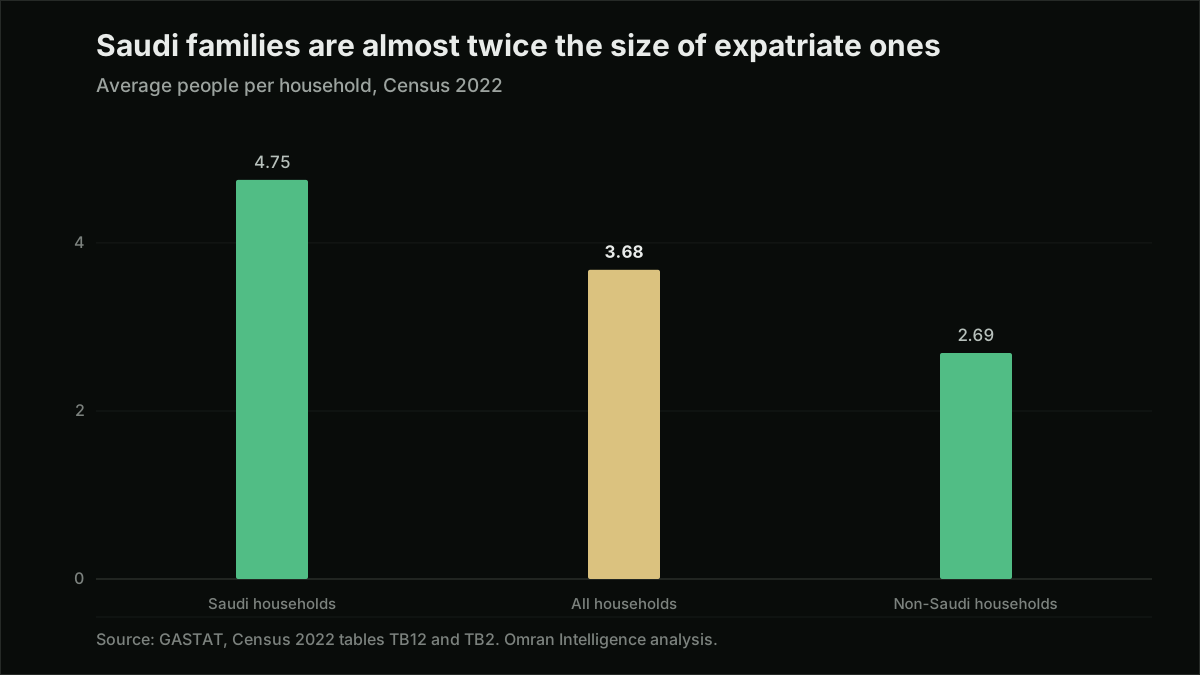
The gap comes from expatriates living alone or in pairs. At the census, 38.45% of non-Saudi households were a single person and 29.83% were two people (census TB2). That is the tenant behind most small flats in the Saudi rental market.
More Saudi households every year
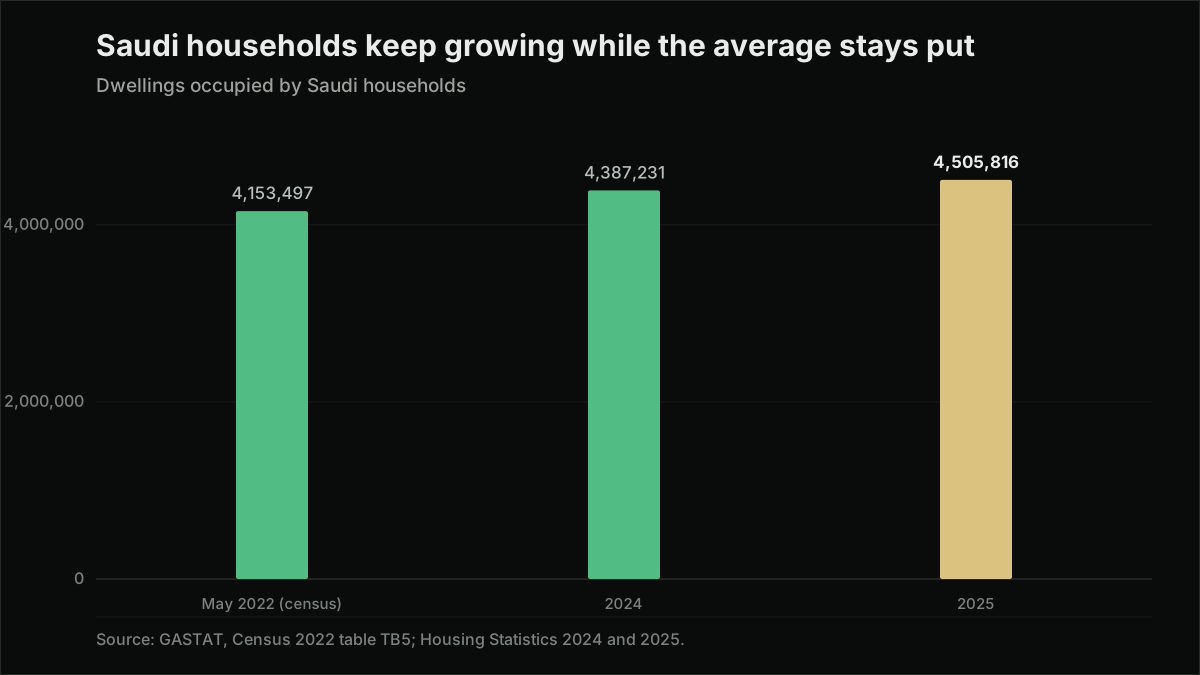
Saudi-occupied dwellings went from 4,153,497 at the May 2022 census to 4,387,231 in 2024 and 4,505,816 in 2025 (2024 workbook, 2025 workbook). That is up 8.5% since the census.
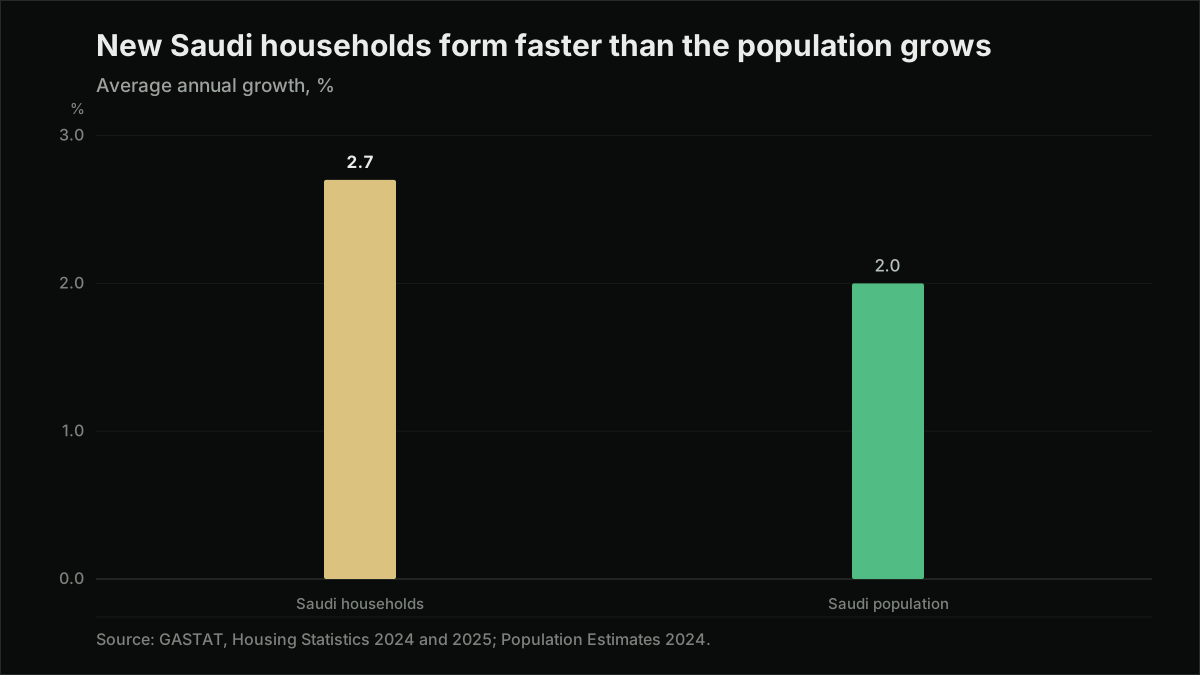
GASTAT puts the growth at 2.7% a year. The Saudi population grew 2.0% a year over the same period, to 19.6 million in 2024. So households are forming faster than people are being added, which means families are getting a little smaller. The drop is too slow to show in an average rounded to one decimal: GASTAT printed 4.9 in 2024 and 4.8 in 2025.
A Saudi household is not all Saudi
Nationality follows the head of household. The 2024 tables count 21,691,129 people in Saudi-occupied dwellings, against 19.6 million Saudi nationals, so at least 2.1 million non-Saudis live in Saudi households. Think of the driver and the housekeeper who live in.
The household figures also leave out workers in labour camps, which GASTAT's definition excludes by name (methodology report).
Why dividing population by household size goes wrong
Feasibility studies often take a population and divide it by 4.9 to get a number of homes. For Saudi families that gives about 4.0 million households, against the 4.39 million GASTAT counted in 2024. The model is 9% short before it starts.
Riyadh shows the same trap from the other side. Saudi households in the Riyadh region averaged 4.96 people in 2024, against 4.94 nationally that year, the unrounded figure behind the 4.9. The blended regional figure is lower only because 56.2% of its households have a non-Saudi head, averaging 2.6 people (DataSaudi). More on the capital in the Riyadh residential market.
What it means for developers
GASTAT counted 118 thousand more Saudi households in 2025 than in 2024. A developer looking at rental stock in Riyadh should work from the non-Saudi figure. How those new households split between renting and buying with a loan links this to the Saudi mortgage market.
Ask for the household table by nationality and region.
Sources and method
- GASTAT, Housing Statistics Publication 2025, Arabic edition: link
- GASTAT, Housing Statistics Bulletin 2025 workbook: link
- GASTAT, Housing Statistics Bulletin 2024, English: link
- GASTAT, Housing Statistics Bulletin 2024 workbook: link
- GASTAT, Methodology and Quality Report for Housing Survey Statistics: link
- GASTAT, Saudi Census 2022, tables TB5, TB2 and TB12: TB5, TB2, TB12
- GASTAT, Population Estimates Publication 2024: link
- GASTAT, Household Income and Consumption Expenditure Survey 2023, via the Internet Archive: link
- DataSaudi, Al-Riyadh region: link
The all-household average weights census city averages (TB12) by household counts (TB2) across 7,203,652 matched households, 88.12% of the total. The Saudi result reproduces GASTAT's published 4.8. Surveys before the 2022 census use a different population base, so we compute no growth rate across them.